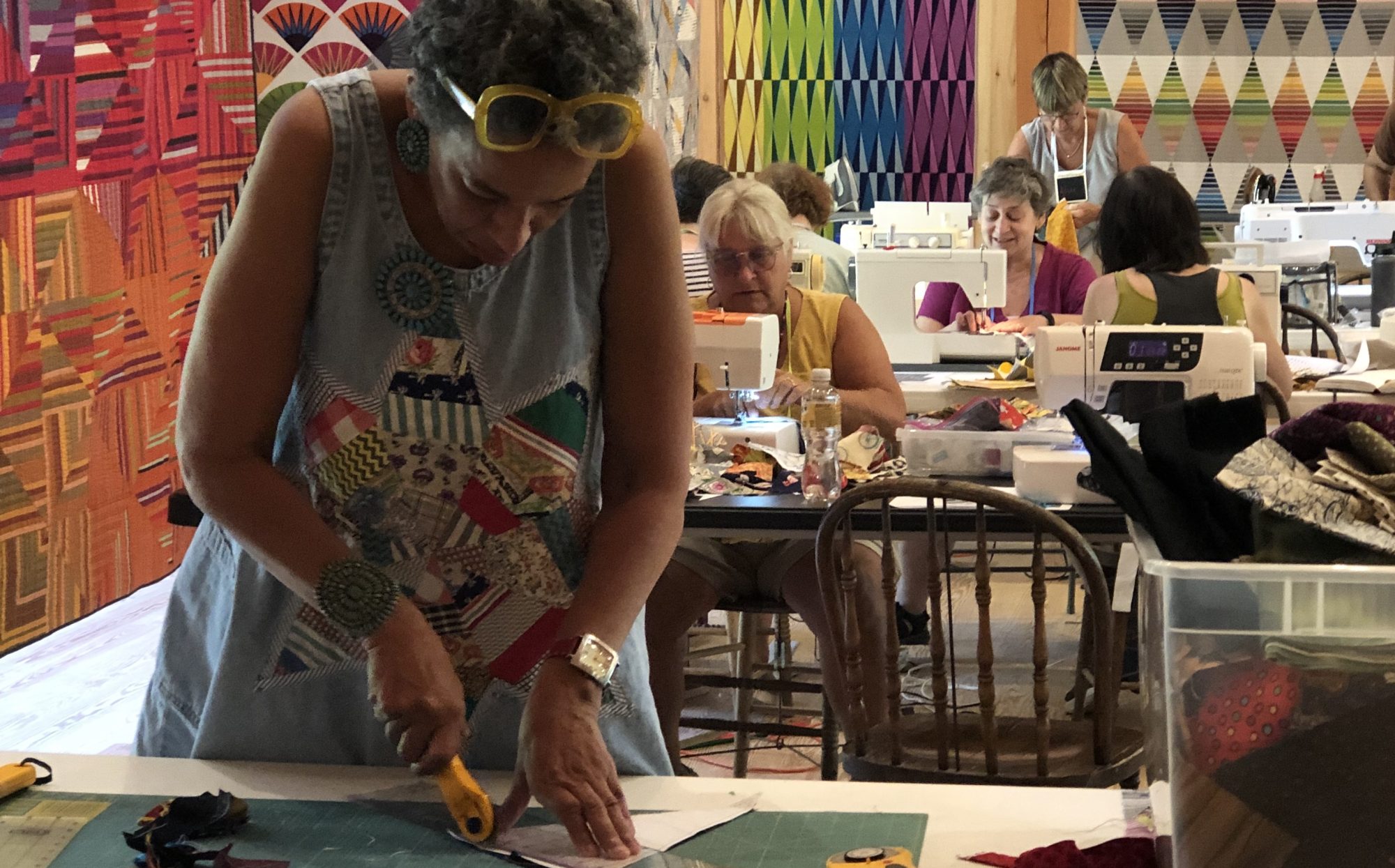
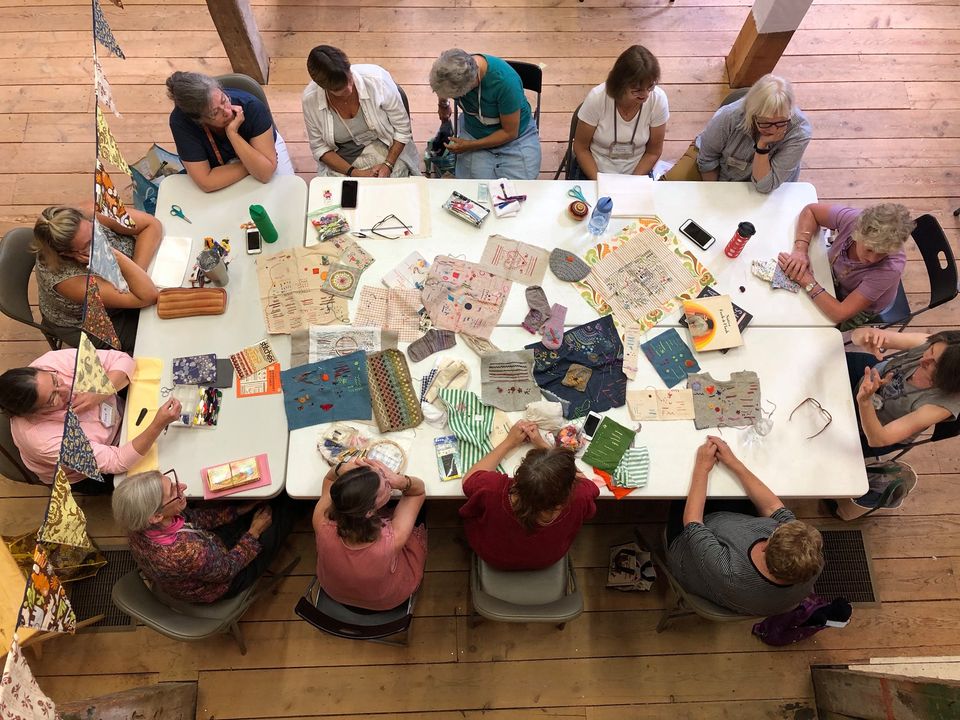
At the Medomak Fiberarts Retreat, you choose your own adventure!
You decide which classes you want to take based on your interests, level of experience, and how full you want your week to feel.
Campers can take up to 6 classes, with multi session classes counting as 1 class. This is so we can keep class sizes small, and also so you don’t burn out! Repeat attendees can attest to the benefits of building downtime into your schedule.
It’s important to note that many classes require significant time spent outside of class if you want to leave camp with a finished project, so keep this in mind as you think about how you want your week to feel. Perhaps one of the most frequent pieces of feedback we get from campers every year is that they wish they had taken FEWER classes, so they could spend more time relaxing and working on projects.
There’s nothing more peaceful and rejuvenating than knitting or stitching in a rocking chair on the porch or while listening to the loons down by the lake, so be sure to keep your schedule spacious if you want to include relaxing in to your week.
Signing up for classes happens online in May, once everyone has registered. Campers will make their 1st, 2nd and 3rd choices for each time slot and be notified of their schedule by mid June. Questions about this process? Reach out at medomakfiberartsretreat@gmail.com
Unless otherwise noted all classes are offered both weeks.
For those contemplating attending the retreat both weeks, rest assured there are so many classes offered, you could take an entirely different set of classes each week and still not get to them all!
ROCK• PAPER • SCISSORS
This year at Medomak, (Cathi’s 7th), she will be offering “Rock, Paper, Scissors” (among other things!). From Japanese Rock Wrapping, to Making Paper, and cutting fabric to make Paper Weavings and Patchwork Puzzle Balls, you will find a number of new offerings. Check them out below!
ROCK WRAPPING & WEAVING ON DRIFTWOOD
Cathi Belcher | 3 hours
If you love rocks, driftwood, knot tying and fiber – and enjoy the Zen-
like calm that comes when creating objects of art from nature … prepare
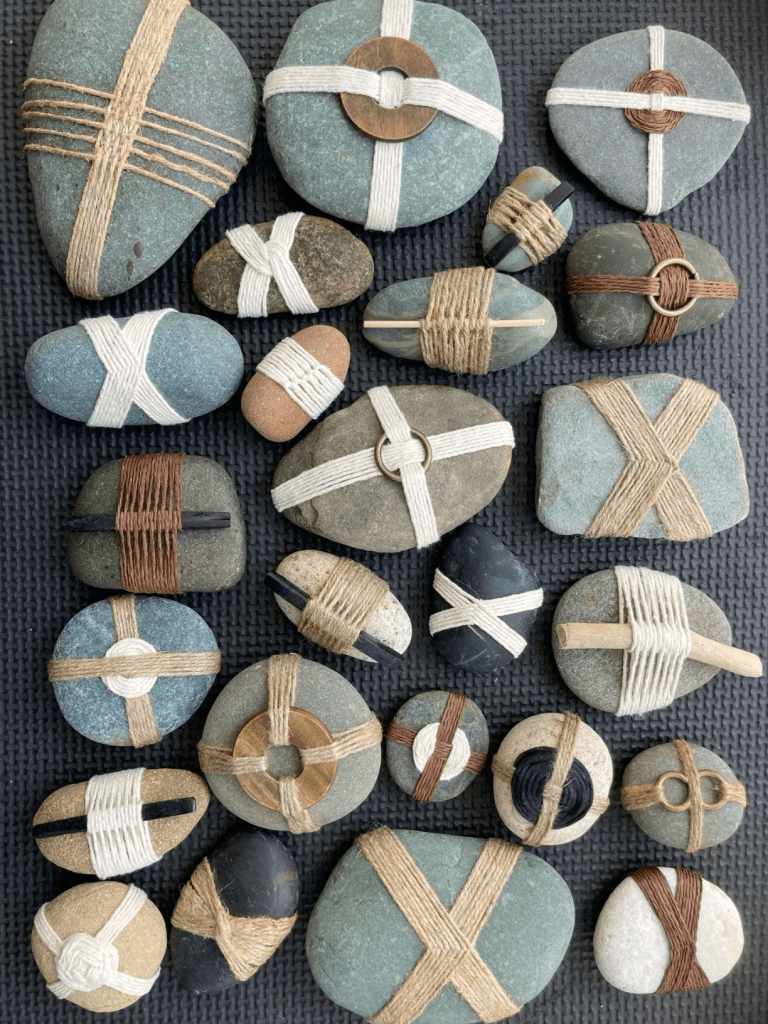
to be en’WRAP’tured! The beautiful art of rock wrapping has its roots in ancient Japan, using oval-shaped rocks wound with twine, leather or cordage. Using knot-tying and basketry techniques, the advanced art can be extraordinarily complicated, but beginner “rock-wrappers” can make gorgeous pieces of art that look complex but are deceptively simple. You will be amazed by your creations from your very first piece. Join ‘petro-phile’ Cathi Belcher, whose life-long love of rocks has led her to
this obsessive fiber-wrapped art. Rocks and driftwood will be provided, but ancient stones have their own unique energies and stories to share, so you are encouraged to bring 3-4 smooth, flat, oval-shaped rocks (about 3-5” long) that particularly speak to you, plus any small pieces of driftwood. Let’s get stoned and drift along in this fun 3-hour workshop!
Materials fee: $15.
MAKING PAPER
Cathi Belcher | 4 hours
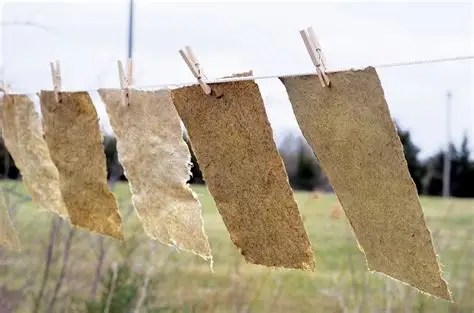
In this workshop we will explore the process of making paper, using a number of different plant fibers and dried flowers, as well as some recycled paper. Using a tool called a deckle and mold, we will each create many sheets of decorative handmade paper that can be used to make books in which to write or draw. While it is drying, we’ll cut other colorful paper to make some very interesting paper weavings. All materials will be provided, just come ready to learn, play and create some beautiful sheets of handcrafted paper. A materials fee of $20 will be collected at the beginning of class.
MAKING CORDAGE FROM NATURAL FIBERS
Cathi Belcher | 3 hours
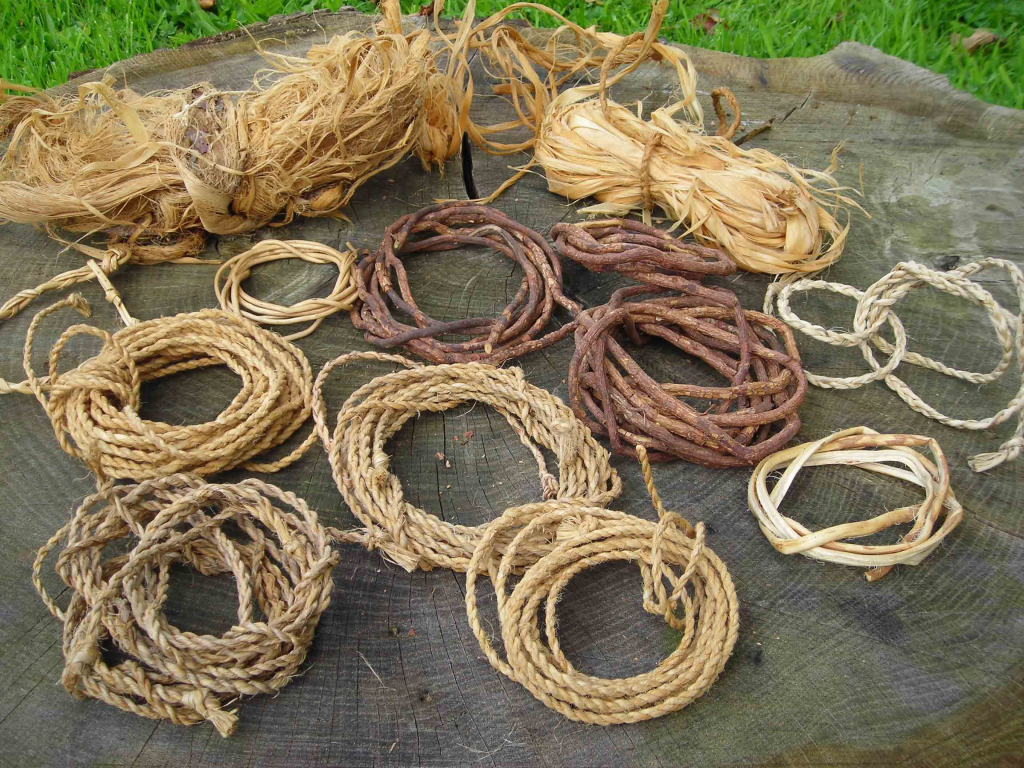
This is a fun and satisfying skill using natural materials to produce strands of twisted (twined) plant fibers. Cordage is beautiful, strong and useful in handcrafted projects such as basketry or anywhere you might use string. We’ll first learn the how-to’s using raffia, and then try our hands using daylily leaves, cattails and other plants, plus, (if there’s time), the basics of paper spinning. In addition to twining, we’ll learn rolling and braiding techniques. By the end of class you will have several small coils of thin twine to use in any number of home projects. (And you’ll never look at plant leaves in quite the same way ever again!). This 3 hour class is open to 12 people. The Materials Fee is $20. In the event that we have time to spin paper, please bring a drop spindle if you have one.
PATCHWORK PUZZLE BALLS
Cathi Belcher | 3 hours
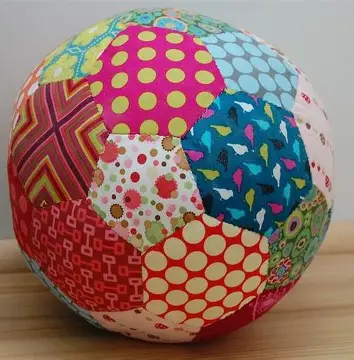
Do you like puzzles? Patchwork puzzle balls are a type of puzzle made especially with fiber artists in mind. In this workshop we will combine simple patchwork shapes to create colorful and perfectly round balls. Use them as decorative accents, holiday ornaments, creative personal gifts, a plaything for your cat, or sweet baby gifts. I’ll teach the basic technique using hand sewing, plus give you the cut materials and instructions to make two other unique patterns. Everyone will receive enough cut geometric cloth shapes to make 3 complete balls; the batting to fill them, plus pins, needles and thread.
Materials fee: $20
COMMUNITY LOOM
Cathi Belcher | ongoing
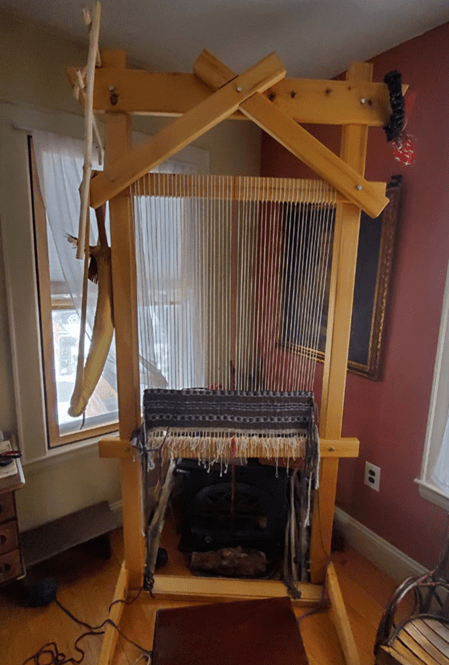
Earth Looms are floor to ceiling looms used in community and group weaving experiences, developed by Weaving a Life founder, Susan Barrett Merrill. Cathi Belcher will have her own 7’ loom, which she made herself of Alaskan yellow cedar, set up on the front porch of the Lodge during the week of Fiber Camp at Medomak. Everyone is invited to be a part of creating daily group tapestries by adding to, and weaving in your own unique threads and fabrics throughout the day. Cathi will curate the loom by taking off finished tapestries and re-warping it for the next one. Each wall hanging will be raffled off on the final night of camp, and proceeds will be donated to the Medomak Scholarship fund. This experience is open to all. You do not have to sign up to be a part of it, but feel free to bring your own materials, textures and embellishments to add your own personal touches. There will also be a communal basket of fibers and fabrics for everyone to use.
The Loom will be set up for weaving for both Week 1 and Week 2
SOLAR PHOTOGRAMS
Rosalba Breazeale (3 hrs)
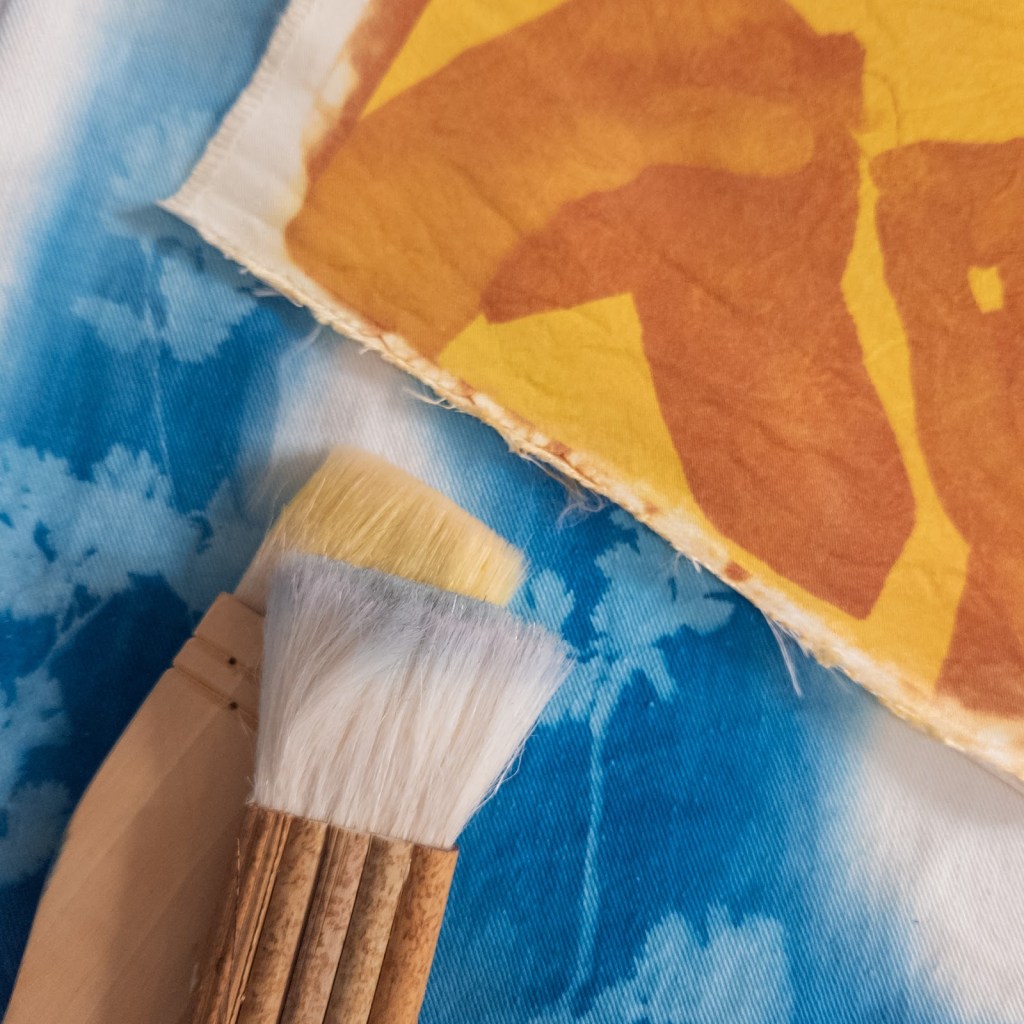
Solar photograms also known as sun prints are a cameraless photographic process that involves placing objects on light sensitive paper and exposing them to the sun. During this workshop, we will make photographs on cotton fabric using natural materials, stencils, negatives and semi-translucent objects. Please bring objects and materials that hold meaning for you and that you don’t mind getting stained. Keep in mind that flatter or 2 dimensional objects will create crisper edges.
A small pack of cotton fabric will be provided, some of which is pre-coated to get you started, and some of which you will learn to coat with cyanotype and solarfast dye yourself. In addition, some stencils, negatives and foraged material will be available for use. No prior experience is required.
Materials Fee: $25
Required Supplies and Materials:
- Objects and materials to make photographs with: natural objects* such as flowers or leaves, stencils, drawings on transparency film, translucent fabric and objects, negatives
- Gloves – Please bring gloves if you have sensitive skin or would prefer not to have stained hands
WEAVING WITH PACHAMAMA
Rosalba Breazeale (3 hrs)
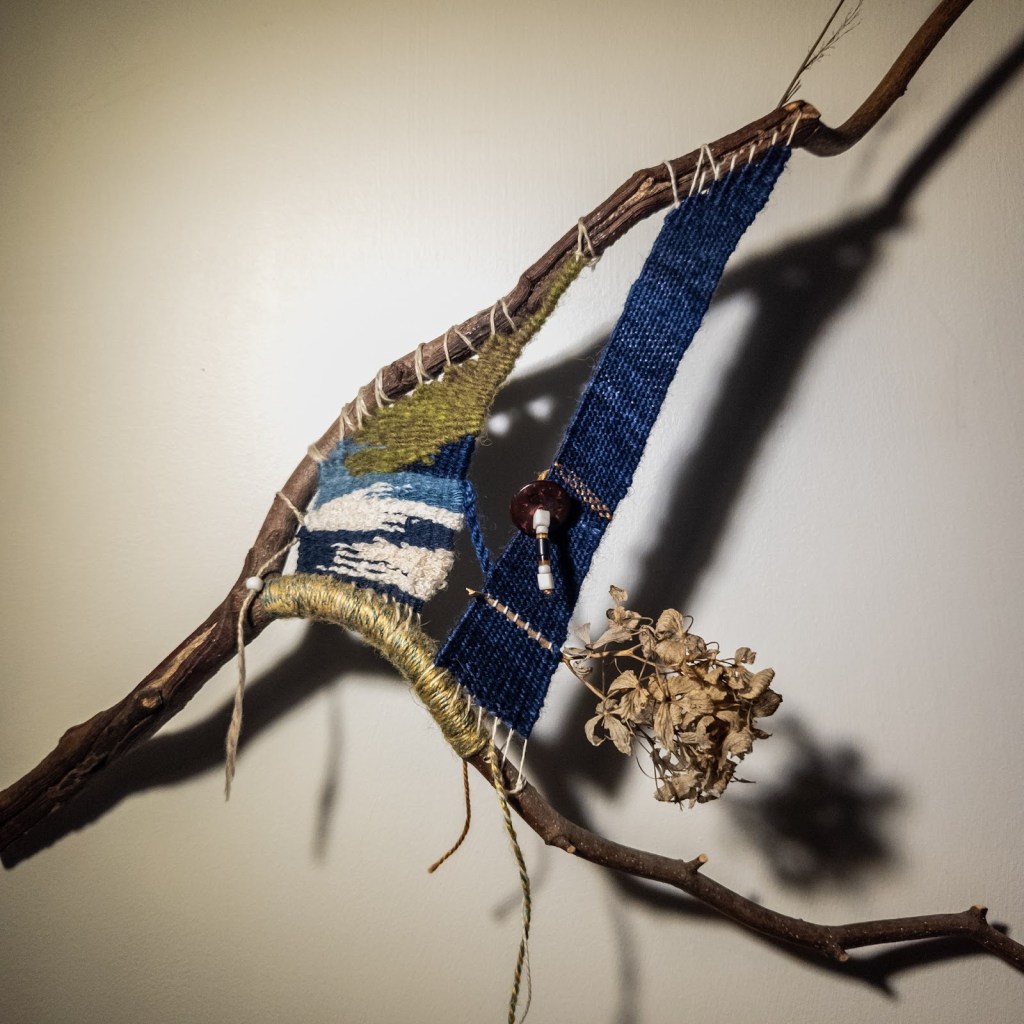
Pachamama is the Quechua word for mother earth, with whom we will be weaving during this workshop. We will create our own unique looms from tree branches by drilling holes for the warp to pass through or by wrapping the warp around the branch. The pattern and materials will be up to you. I will provide instruction on basic tapestry weaving techniques for those who are interested. No experience necessary.
There will be a small communal pile of materials available for $20 consisting of a variety of yarn, recycled and responsibly foraged materials.* Additional tools available include: 2 battery powered drills, glue, parchment paper, clamps, extra tapestry and sewing needles, scissors
Required Supplies and Materials:
*Tree branch – Please bring a tree branch with V or U shape that is at least ¾ in. in diameter if you want to drill holes for a warp. Size may vary. If you would like to complete the weaving within the workshop period, I suggest a maximum size of 12 in. x 12in. Freshly downed or responsibly pruned branches are best as they need to withstand tension while weaving.* If you are unable to forage for your own tree branch, I will have pre-warped branches available for $25.
*Weaving material – get creative by using yarn that has been sitting in your stash for years, incorporate roving, find recycled yarn at the thrift store (ensure it is not insect infested before introducing it to your stash), cut strips of colorful plastic or wire, forage responsibly for plant materials. You can, of course, buy yarn but I encourage you to give mother earth a break by utilizing what already exists and is plentiful in this world.
- Tapestry Needles – at least one, more if working with multiple colors
- Sewing Needles – size based on weft material and drilled holes
- Battery powered drill with small drill bit – Optional, but suggested if you want to get weaving faster. Drill bit size: 1/16 or 3/32 for finer warps.
*A note on foraging: When foraging, please do so responsibly. This means: know what you are harvesting, always leave plenty for animal and insect friends, and for the plant to reproduce. Please be aware of invasive plants and insects, and do not transport any material that may be or may carry them.
NATURAL DYES
Rosalba Breazeale (6 hours over 2 sessions)
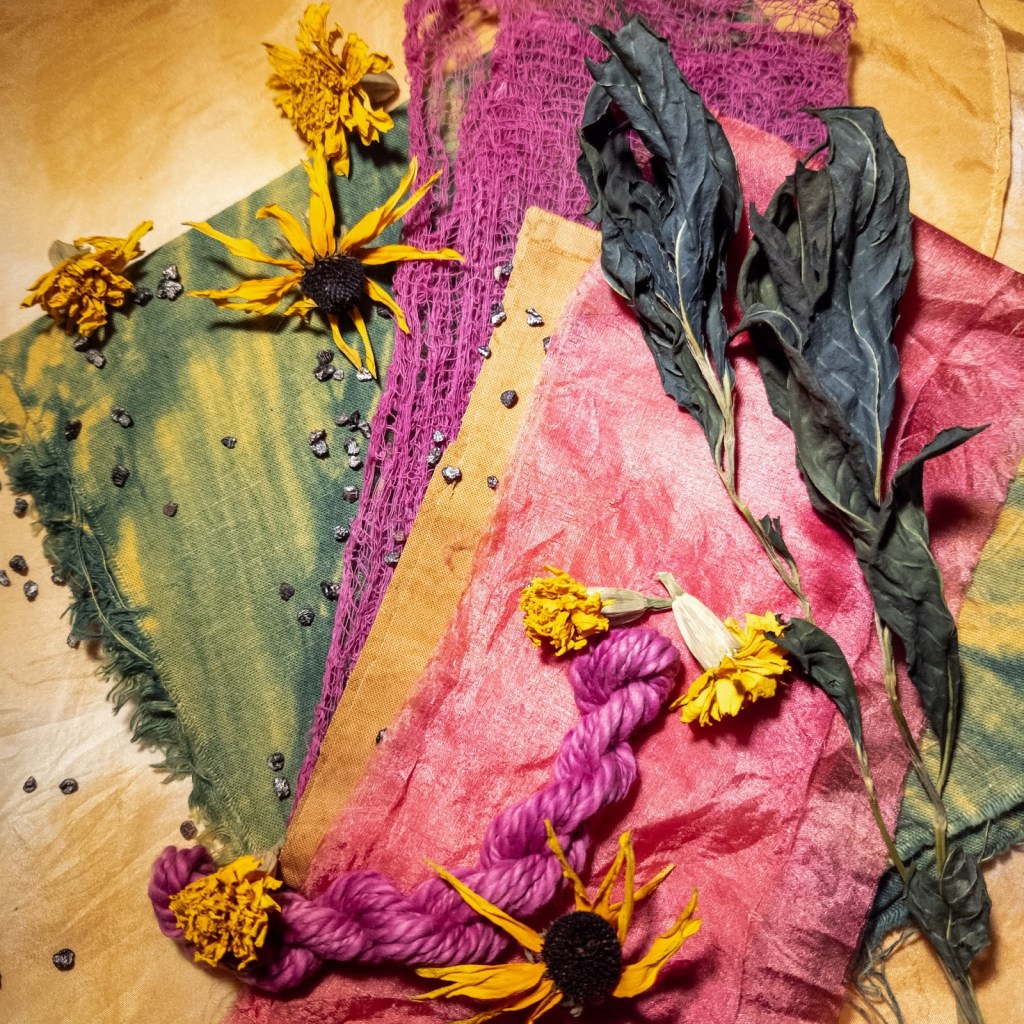
During this natural dye workshop, we will explore Immersion dyeing practices from Abya Yala and Turtle Island aka South, Central and North America, creating beautiful color variations through the practice of overdyeing and color shifting. Our exploration will reveal a rainbow of harmonious colors using dyes from South, Central and North American dye traditions, including an indigo vat, and a touch of iron powder. In the morning, we will focus on creating communal dye vats of base colors: red/magenta, blue, and yellow. In the afternoon, we’ll get a little wild by introducing additional dyes and using acids, bases and iron to shift and expand our dye palettes.
Bring rubber gloves if you have sensitive skin or would rather not have dyed hands, but they are not necessary otherwise. Wear clothes you don’t mind getting stained. Materials kit will include a prepared fibers pack & index cards to keep dye notes. You may bring extra cotton, linen or wool based fabric to dip in the Indigo vat IF it is not exhausted by the end of the class. No previous dyeing experience required.
Materials Fee: $22
Optional Materials:
*Gloves
*Additional fiber for Indigo Vat
INTRO TO BACKSTRAP WEAVING
Rosalba Breazeale (4 hours over 2 sessions)
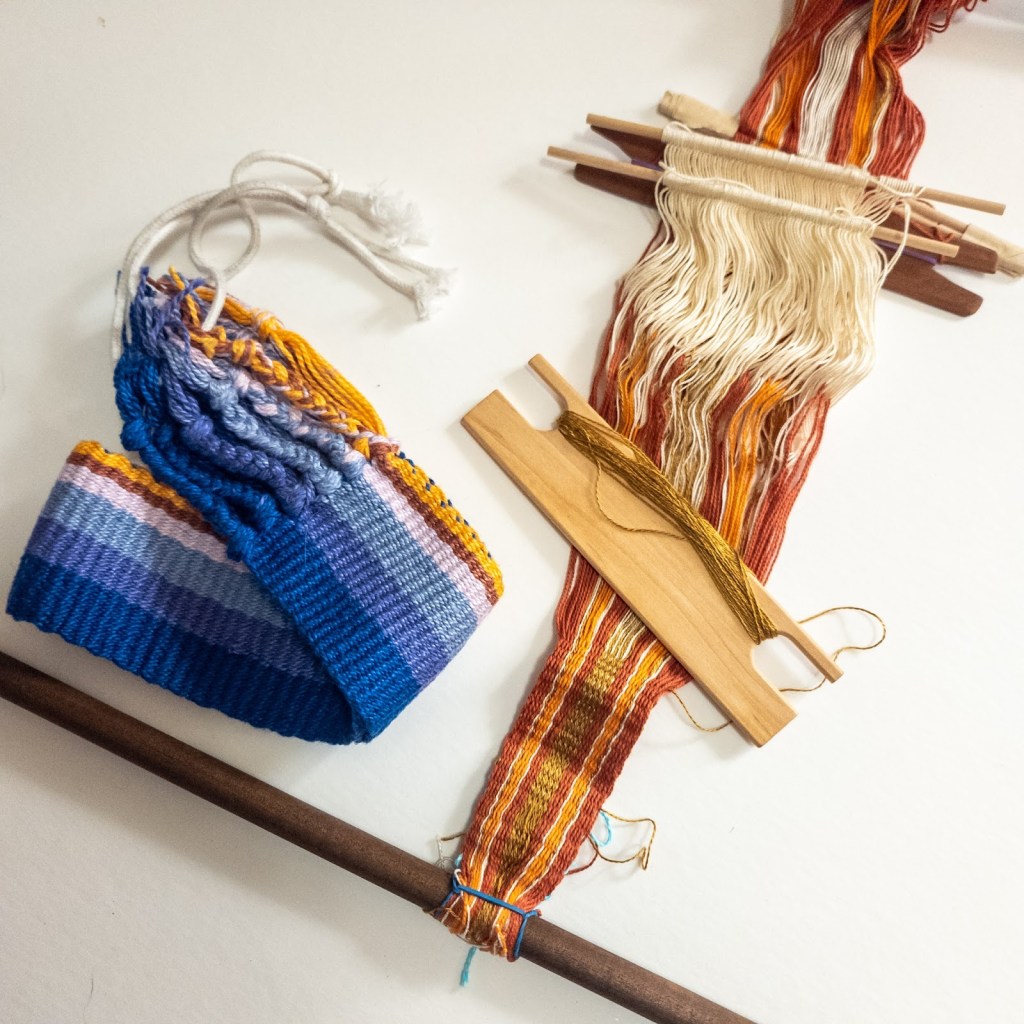
Backstrap weaving is one of the oldest forms of weaving that is still used by many Indigenous cultures across the world. We will be focusing on the Andean tradition. In its essence, the backstrap loom is made of wooden sticks and yarn. We will wind a one yard warp and create a plain weave pattern. It is highly unlikely that you will complete the woven piece within the 4-hour workshop period, but verbal and written instructions will be provided on how to finish along with an assortment of resources for future weaving instruction.
A kit for the basic backstrap loom components will be provided, but you will need to purchase additional tools and materials separately.
Experience Necessary: You will need to have an understanding of basic weaving structure (warp and weft). Warp faced weaving experience, such as with inkle weaving, is helpful, but not required.
Materials Fee: $15
Required Supplies and Tools:
- Stick Shuttle (12-14 in) (1 Required, (a second one optional))
- Warp Yarn – 8/2 or 5/2 or crochet mercerized cotton (Required: 1 color, 3 colors max)
- Weft Yarn – 8/2 or crochet mercerized cotton (Required: 1 color – should match one warp color if you don’t want it to show on the sides)
- Weaving sword or batten (optional)
- 2 clamps (optional, but recommended for weaving outside of the workshop). Suggested clamps can be found here.
KEEPSTITCH: MEMORY QUILTS FROM MEANINGFUL FABRICS
Katherine Ferrier | 9 hrs over 3 sessions
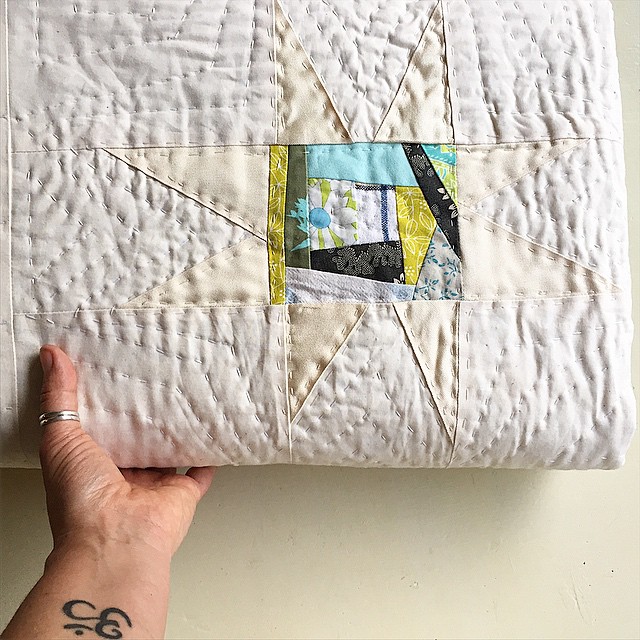
Textiles are inextricably connected to our bodies, and hold memories and meaning long after they’ve outgrown their original purpose. What do we do with the precious textiles that hold the history of a life: the outgrown baby clothes, the well-worn flannel of a loved one, or the linens from a home left behind? These fabrics are more than mere material; they are composite bodies of history and haptic memory, holding lifetimes of sentiment and story.
In this 3 part workshop, you’ll design and make a one-of-a kind quilt, using fabrics that hold meaning for you or someone you love. You’ll learn how to prepare fabrics of various weights to be sewn together, how to map out a design, the secret to figuring out sewing order when making a patchwork, how to “square up” your quilt top, layer the top, batting, and backing, and several methods of finishing your quilt. If you’re brand new to sewing and patchwork, expect to make a wall hanging sized piece approximately 2′ x 3′. Experienced sewists (or motivated night owls!) can take on bigger sizes. Either way, expect to be working on your project outside of class time if your intention is to finish while at camp.
Previous experience needed: While it might help to have some basic sewing knowledge, we’ll move at a pace where no one is left behind. If you’ve never used a sewing machine before, or dabbled at all in any kind of patchwork, that’s ok too! You’ll learn how in this class!
What to bring:
• An assortment of 5–10 items of clothing or meaningful textiles you are willing to cut up and transform. These can be either woven (like a button down shirt) or knits (think t-shirt) but keep in mind, patchwork with knits can be a bit challenging for a beginning sewist. If you have questions, bring more than you think you’ll use, so you have options.
• A basic sewing kit, including fabric scissors, straight pins, safety pins (bigger ones are easier to use) and a seam ripper.
• A sewing machine, if you have one. (A limited number are available to borrow, with advanced notice.)
• Enough fabric for the back of the quilt, either whole or pieced together.
• Batting, the size of your finished top
Materials provided:
I will have a bin of scrap fabrics you’re welcome to use. I will also have several bolts of cotton fabric for backing as well as some cotton batting available to purchase by the yard.
An instruction booklet and mini sewing kit with quilting thread and a Sashiko needle will be provided for a materials fee of $10.
MORNING MOVING & WRITING FOR MAKERS
Katherine Ferrier | 5 hours over 5 days
This one hour morning workshop will gently wake you up, ground you in your body, and get you ready for a day of making. Designed for early risers, we’ll meet before breakfast each morning, and divide our time between moving meditation, making, and contemplative writing. We’ll begin with some gentle movement exercises inspired by Qigong and other somatic practices to open and wake up the body. We’ll then spend some time in quiet, meditative handwork, each tending to our own projects. From this place of deep listening and connection, we’ll dip into some guided free-writing, working with a variety of open-ended prompts. There will be optional time at the end for sharing our writing with each other so that we might deepen our appreciation of how our personal stories connect us, but never any pressure.
Materials to bring: Wear loose comfortable clothing, and bring some handwork and a journal. It’s best to bring something you can work on without concentrating too much, so your thoughts can drift into the rich realms of memory and meaning.
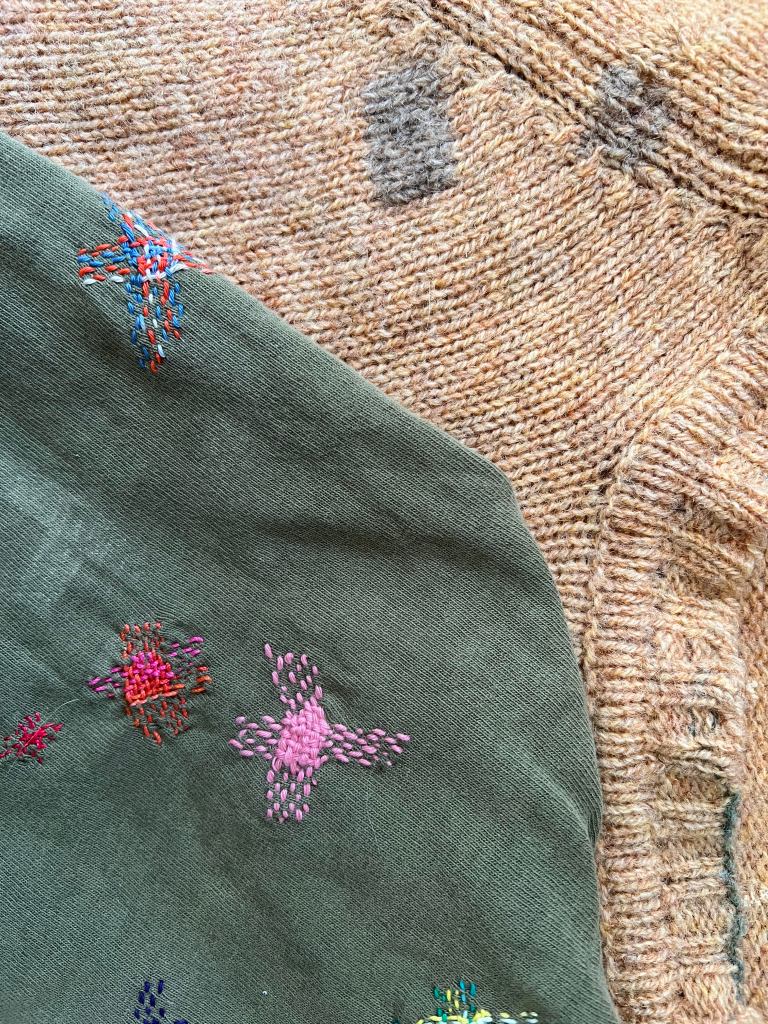
ONCE MADE, TWICE MENDED: VISIBLE AND INVISIBLE MENDING IN KNITWEAR
Bristol Ivy | 3hrs
Mending our knits is a gift to our past and future selves: it honors all the hours we spent in the making process, AND it keeps these garments in our wardrobe for years to come. In this class, we’ll cover several techniques for either the technical wizardry of mends that disappear, or bright and bold mends that add their own flair and ornamentation.
Experience needed: knitting, patience!
Homework: none
Materials: tapestry or darning needles, 20 yards [18 m] of light-colored waste yarn, any knit items (hand or machine knit) that might need repair and yarn to either compliment or contrast with them, writing implement for taking notes
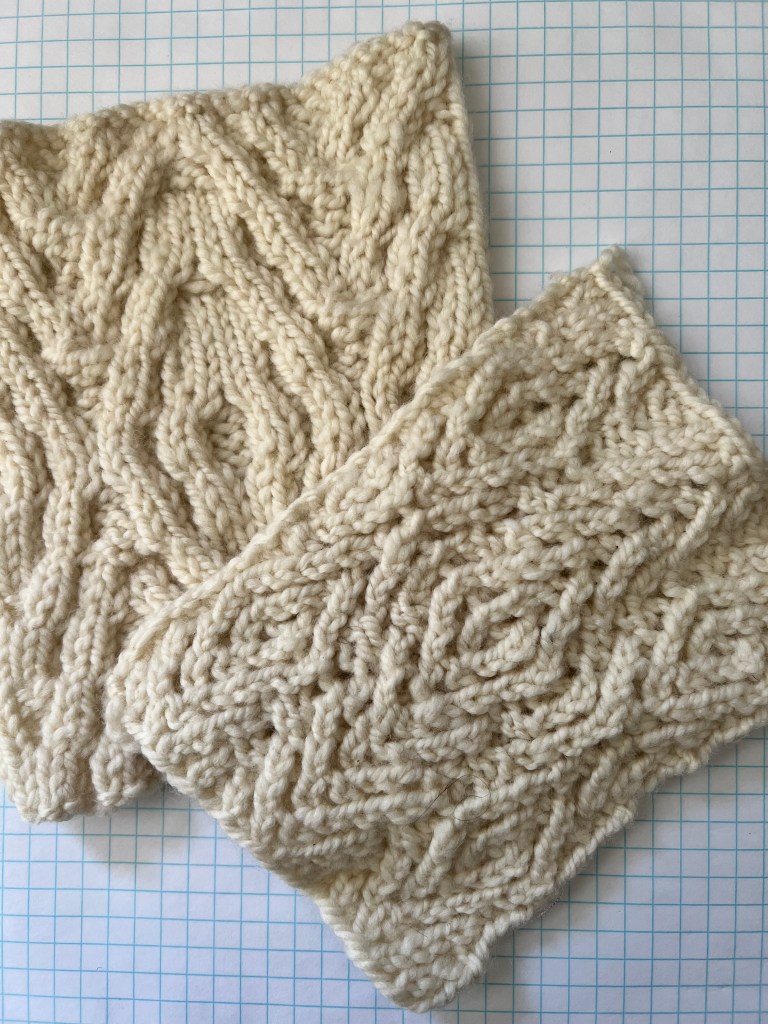
SECRET CABLES: ENCODING MESSAGES IN TWISTS AND TURNS Bristol Ivy | 3hrs
In this class, we’re going deep into nerd territory! Starting with a code based on Japanese stitching, we’ll turn words and numbers into beautiful cabled and twisted stitch patterns that hold secret meaning AND keep us warm!
Experience needed: knitting, purling, cabling, comfort with charts.
Homework: think of some 4-8 letter words you might like to encode!
Materials: 80 yards [72 m] of light-colored worsted or bulky weight yarn, and knitting needles to match. Please also bring graph paper if you have it, a pencil with a good eraser, and a pencil sharpener
BEAD EMBROIDERED JEWELRY
Bristol Ivy | 4 hours
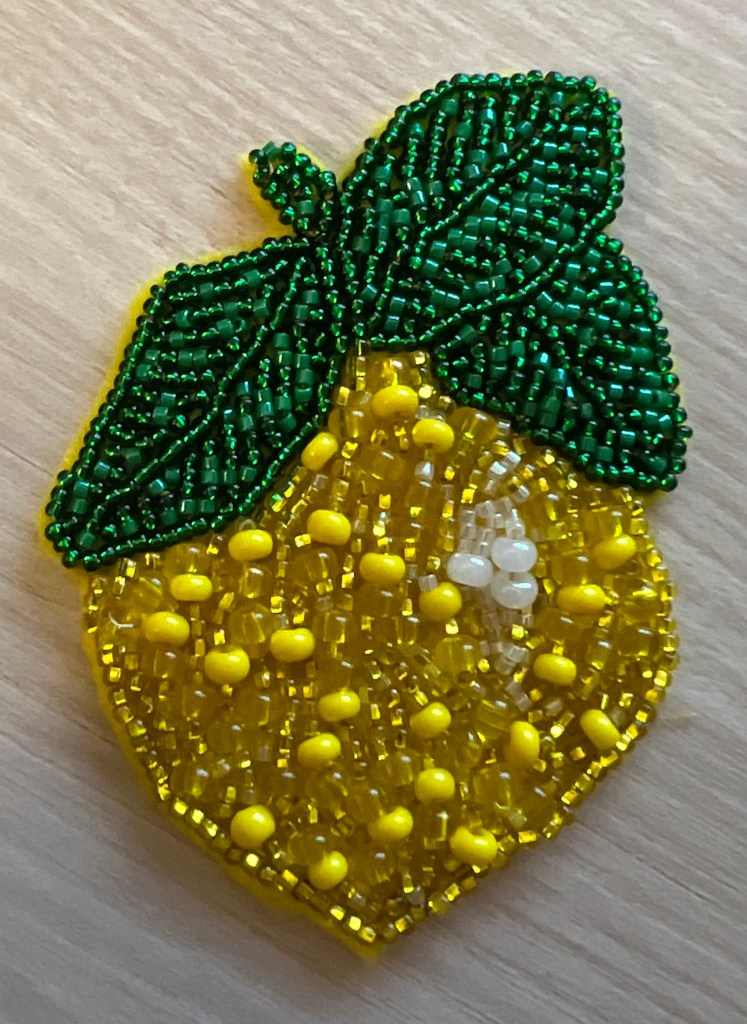
Beadwork and bead embroidery has roots in cultures across the globe, and it’s a wonderful and meditative way to create your own piece of miniature art! In this class, we will learn the principles of couched bead embroidery, and start working on either a pair of earrings or a single brooch. (Photo below is an example, and not necessarily the project you’ll be making in this class. You’ll have several designs of varying complexities to choose from.)
Experience needed: some hand-sewing experience
Homework: none
Materials fee: $16
EEK! STEEKS!
Bristol Ivy | 3 hours
Cutting your knitting—the final frontier! Steeking can be one of the scariest but also one of the most liberating techniques in knitting. We’ll use one big circular swatch to explore different methods of securing our steeks, cutting them, and finishing the fabric afterwards. Bring your sense of adventure and courage!
Experience needed: knitting in the round, some hand-sewing experience, ability to single crochet or slip stitch crochet
Homework: with NON-SUPERWASH worsted weight wool yarn and a US 7 needle, please cast on 90 sts. Join to work in the round. Work in stockinette in the round until work measures 4” [10 cm] in height. Bind off.
Materials: 20 yards [18 m] NON-SUPERWASH fingering weight wool yarn, 3 mm crochet hook, sharp scissors
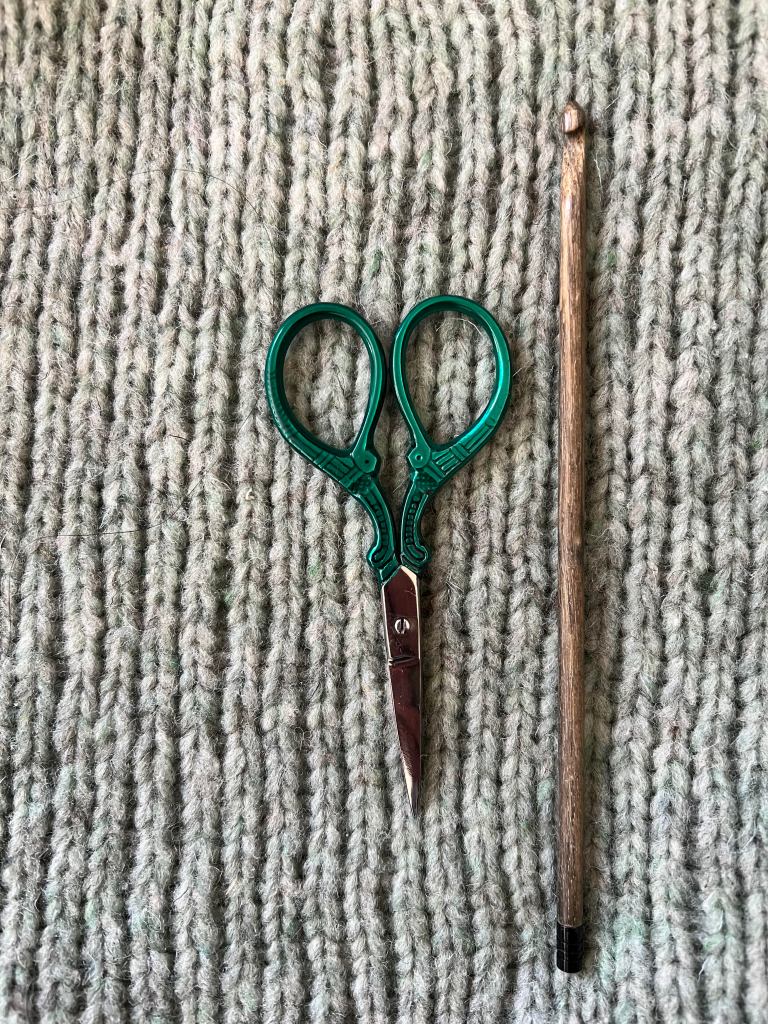
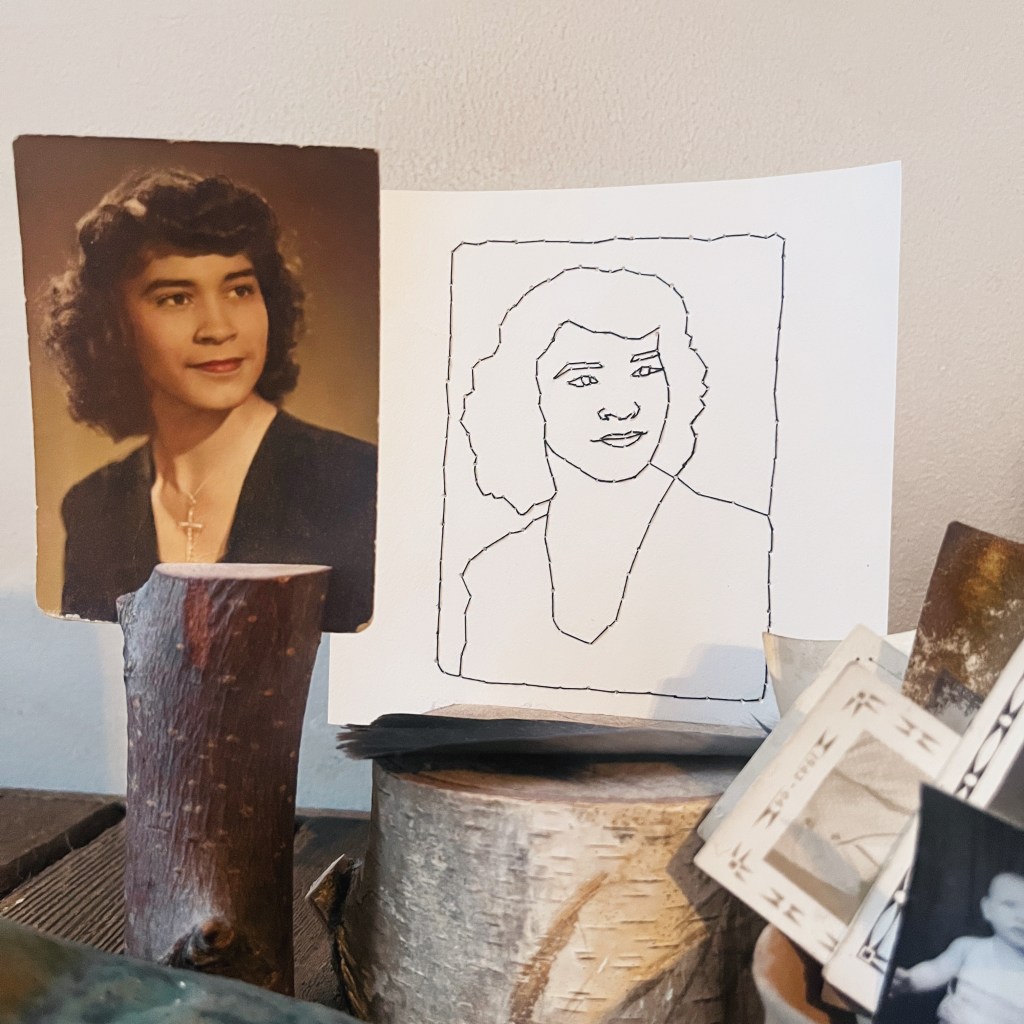
PHOTO TO THREAD: EMBROIDERY INSPIRED BY PHOTOGRAPHS Jessica Marquez | 3 hours
Turn found or personal photographs into embroidered artworks. In this class, we’ll explore ways to transfer photographic images into designs on fabric and paper and use embroidery stitches to capture texture and form. Feel free to bring images or photocopied images to work from. Jessica will also bring images, fabric, and thread to share. Students will leave with a started embroidery piece and techniques for transforming meaningful images into thread.
All experience levels are welcome!
Materials fee: $15
BOTANICAL EMBROIDERY
Jessica Marquez | 3 hours
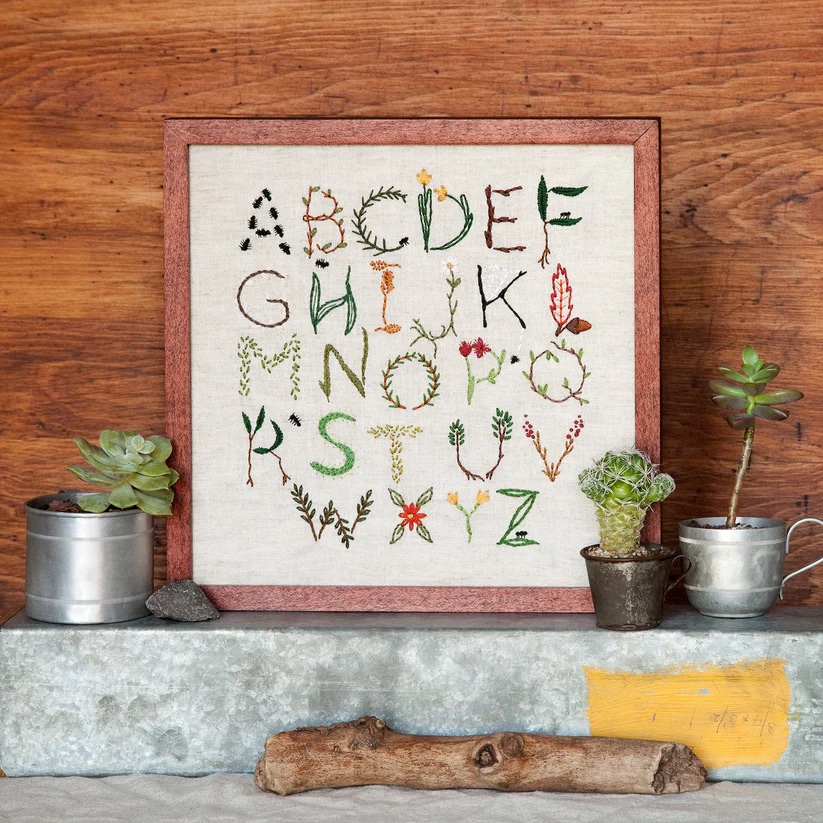
Learn the basics of embroidery and expand on your skills with an open ended nature inspired sampler. When I was little the backyard was a magical place to explore. Under a canopy of leaves there were flowers, sticks, stones and insects to discover. This embroidery sampler is inspired by that wondrous feeling. The sampler is pre-printed on a 12 inch square of lovely linen fabric and filled with lots of details to stitch. Some embroidery experience is helpful, but this class is open to all experience levels.
Bring scissors. Materials kit provides everything else you need. $25
STITCH • RESIST • SHIBORI
Jessica Marquez | 6 hours
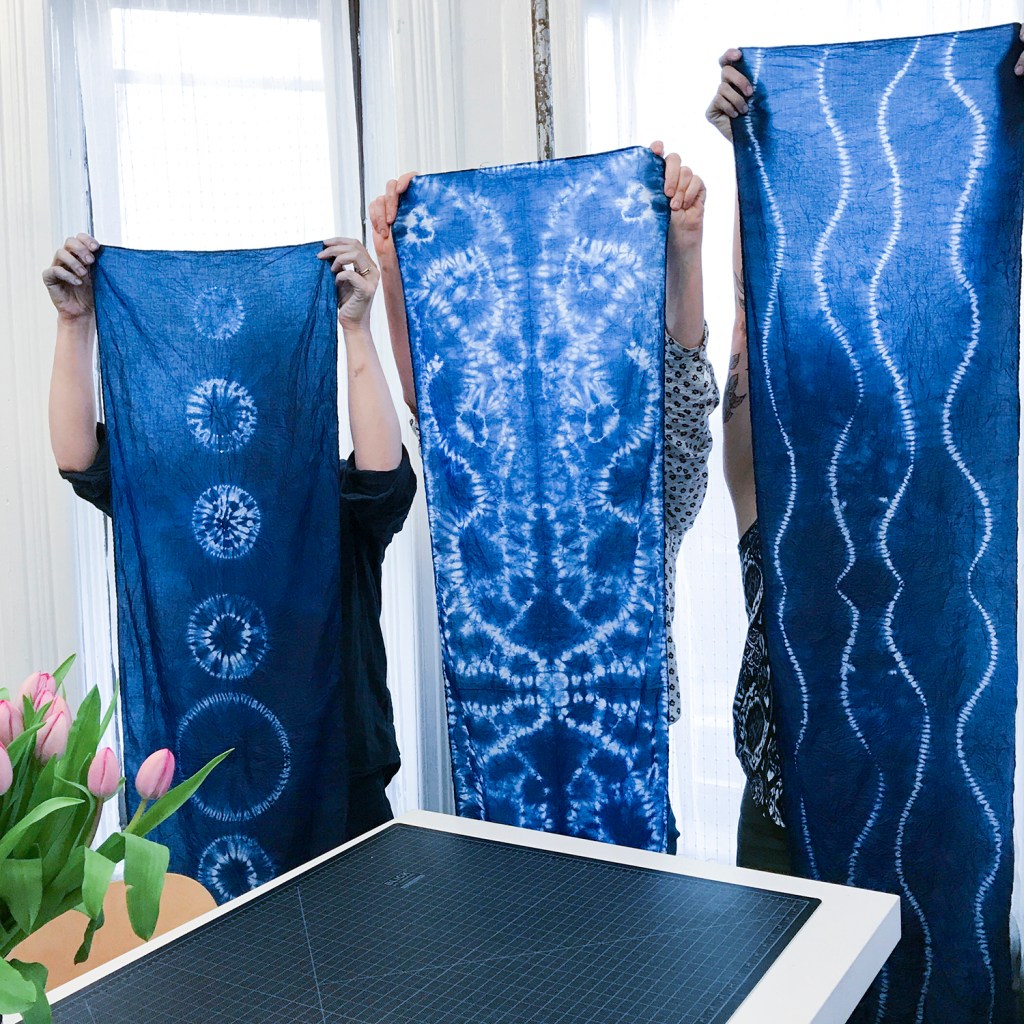
The Japanese art of shibori uses folds, twists, ties, and even stitches in fabric to create patterns with dye. Stitch resists are particularly interesting to play with, because you can create intricate, detailed patterns, even text, with the organic look of shibori. Students will learn several stitching techniques, how to layout a repeat pattern, prep materials for dye and dye their own one-of-a-kind indigo piece. Students will be provided with cotton scarves and bandannas to dye, but can also get creative using their own clothing. No experience needed: beginners welcome!
Materials fee: $25 includes: indigo dye, cotton blank, sashiko needles, drawing tool, button craft thread, and seam ripper.
INTRO TO SASHIKO
Jessica Marquez | 3 hours
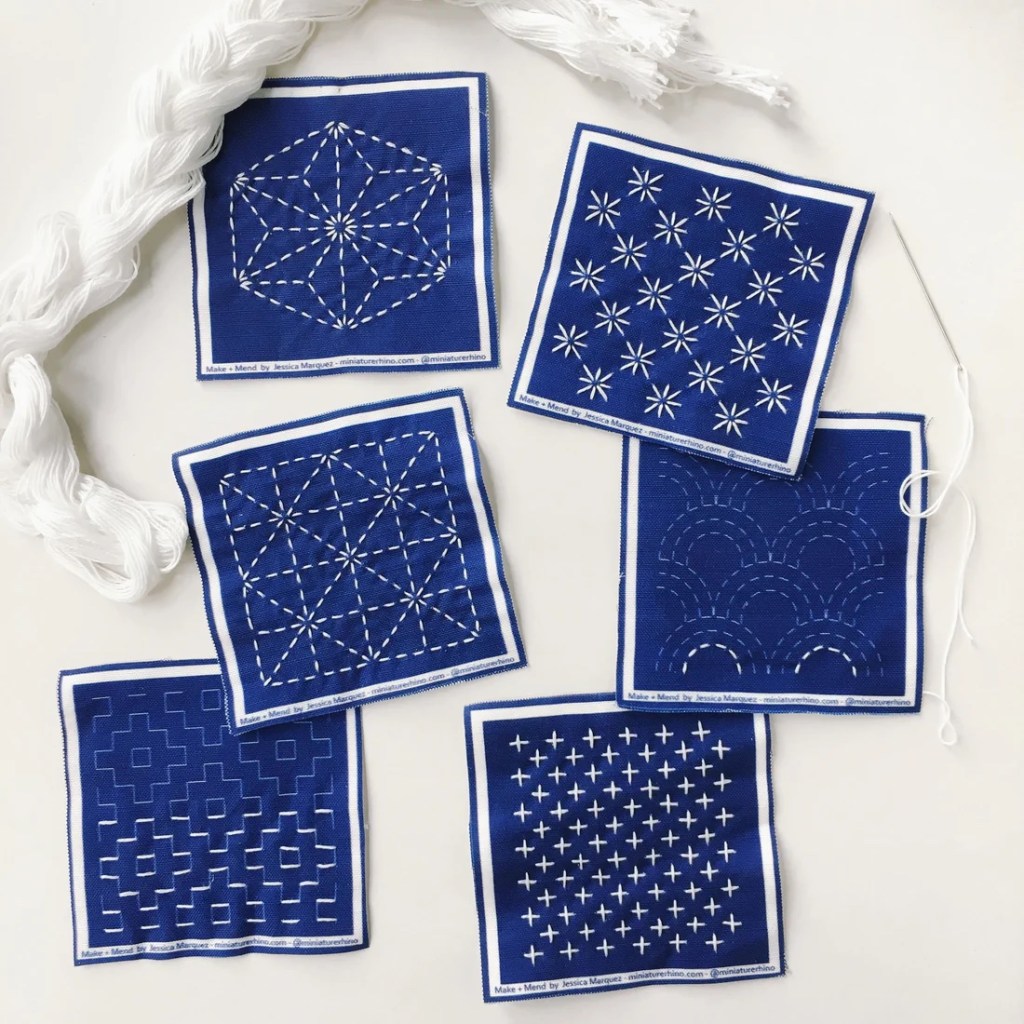
Learn the basics of the beautiful, pattern filled Japanese technique of Sashiko. This class introduces students to a suite of six classic Sashiko patterns in two different styles. The patterns are pre-printed, so we can jump right into stitching while learning about: the characteristics of sashiko patterns, how to prepare thread, my favorite tools and materials, and how to stitch sashiko patterns. Use your finished piece as a sampler, patches, coasters, sachets, make a pillow or anything you can imagine!
It’s doesn’t get much easier than this! The patterns are printed right on a canvas fabric, so just follow along the printed lines. No embroidery hoop necessary. That’s one of the best parts of sashiko- its simplicity. All you need is right here (plus some scissors). Perfect for the curious beginner or skilled maker looking for a fun project.
Kit Includes
+ Six 4″ fabric squares printed on linen cotton
+ 100% cotton sashiko thread
+ set of Olympus sashiko needles
+ minimal, easy to follow instructions
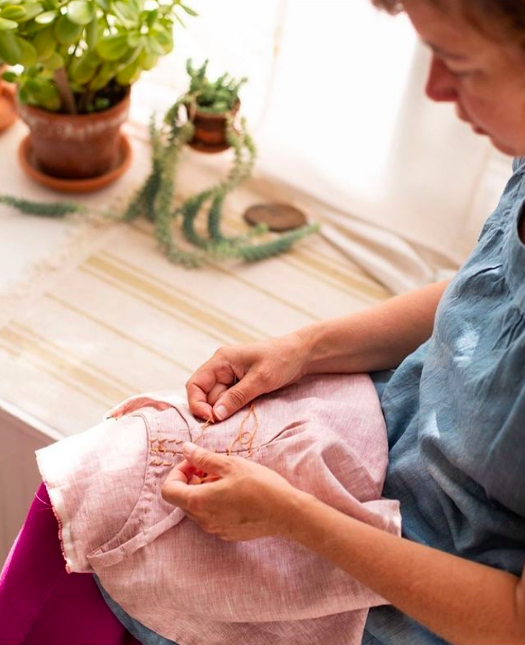
HAND STITCHED SHIRT
Cal Patch | (6 hours over 3 days)
Sewing on a machine is quick and practical, but for many it’s difficult to find the dedicated time and space required to make it a regular habit. Moving your sewing practice into the realm of handwork (like knitting, crochet, and embroidery) means you can stitch up garments whenever (and wherever) you have a few spare minutes, or on the couch at night while watching a movie, and carry a project with you so you always have it. Amazingly, you might find you can finish a hand-sewn garment sooner than a machine-sewn one!
We will work with a pattern (see supply list for options) for a simple, boxy top and learn how to sew seams, finish necklines and hem edges with only your hands and a needle and thread. Several methods for each type of seam will be shown, so you may also create a sampler of extra techniques.
No prerequisite skills, though an understanding of basic sewing principles will be helpful. You will need to have your pieces (front and back only, skip any facings) cut out before start of class.
Supplies needed:
*Pattern for simple top (see list below)
*Fabric: light-to-medium weight woven cotton, linen or blend. Quantity as indicated for your size** on pattern, but 2 yards is probably sufficient for most. Solid fabric is best to see your stitches, but print is ok too.
*Front and Back pieces ALREADY CUT OUT of your fabric (no need for any facings included in pattern). Please use simplest version with no added seams or sleeves!
*Fat quarter or approximately 12-18” square of similar or same fabric (could be a scrap left over after cutting) for sampler
*Bias tape, 1 yard of ½” single-fold, can be self-made or packaged
*All-purpose thread, can be contrast (to see your stitches) or matching and/or size 8 Perle Cotton
*Hand-sewing needles in a few sizes, or your favorite size
*Pins
*Scissors
*Marking tool (chalk, wax or pencil) and ruler
*Optional: Thimble
Please use one of the following patterns:
Boxy Tee/Drapy Tunic: drafted in a previous class with Cal, or from her online video class, or tutorial found on her website (NOTE: please just do the simple version without the seam and pocket): https://calpatch.com
Lou Box Top https://www.sewdiy.com/shop/lou-box-top-pdf-pattern
Fen Top https://fancytigercrafts.com/products/fen-pdf-pattern
All Well Box Top https://www.etsy.com/listing/713038843/all-well-box-top-sewing-pattern-hacking
Maya Top https://www.etsy.com/listing/206020747/pdf-maya-dress-and-top-sewing-pattern
Shirt No. 1 https://shop.100actsofsewing.com/products/100-acts-of-sewing-shirt-no-1-sewing-pattern
**These are loose-fitting tops, so you should be fine to choose the size called for according to your measurements. But if you are very concerned about a perfect fit, you may wish to machine-stitch a muslin/fit sample first to confirm size.
SCRAPPY HUSWIF
Cal Patch (4 hours, over three sessions)
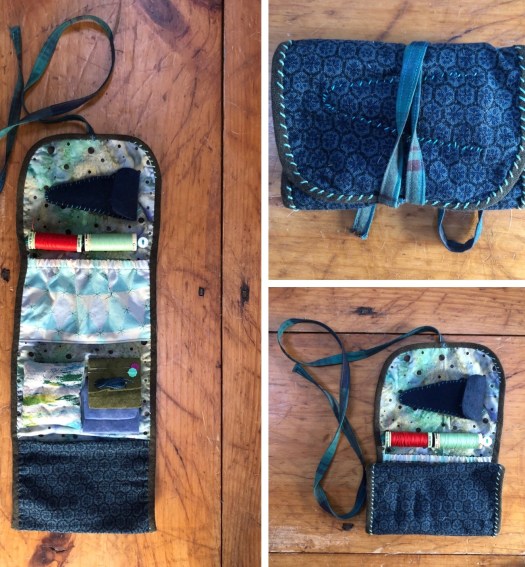
Continuing on with our collective obsession with scraps and scrap-inspired projects, Cal will lead you in making a modern version of a 19th-century “Huswif” or “Housewife”, a sewing pouch that holds all the essentials to take with you everywhere. We will use scraps and small pieces of fabric to sew (by hand, or machine, or a combo) a kit with customized pockets for your tools and a built-in needle book, pincushion, thread-holder and scissors keeper. Bring your favorite small scissors and other travel tools, preferred type of thread and any favored fabric scraps, buttons, ribbons etc that you have, both to use for your project, and so that you can design your pouch to fit the kinds of things you use and carry! Please aim to buy nothing for this class, but rather to bring what you have. Don’t worry if you don’t have something; bring extra of what you do have to share, and it will all work out.
Supplies:
— Sewing machine if you want to use one (we will have some on hand to use)
— Fat quarter or approximately 24” x 8” of outer fabric (any sturdy woven cotton, linen etc, quilting cotton is great)
— Same size of another fabric for lining (quilting cotton or similar)
— Scraps for the smaller bits (Don’t have scraps? Don’t worry! we will have scraps on hand!)
— All purpose thread, or heavier/embroidery threads if hand-sewing
— Hand-sewing needles, assorted (or your favorite type + size)
— 1 yard of bias tape, 1/2” or “extra-wide” double fold
— 1 yard of ribbon, twill tape, etc to tie it shut
— Small piece/s of elastic, 1/2” wide or smaller
— Optional supplies to bring if you have: wool (or other) felt, buttons, ribbons or other trims
BLOCK PRINTING + STENCILING FOR TEXTILES
Cal Patch | 3 hours
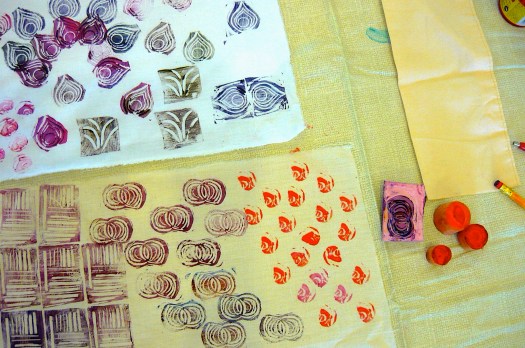
In this workshop we will explore simple techniques for printing and stenciling on fabric with readily available materials, found at your local grocery or art supply store. We will carve our own stamps and print on a variety of fabrics, and everything we do will be easy to repeat at home. These skills will prove useful for all sorts of textile projects!
All supplies included, though feel free to bring fabric you’d like to print on.
Materials Fee: $5
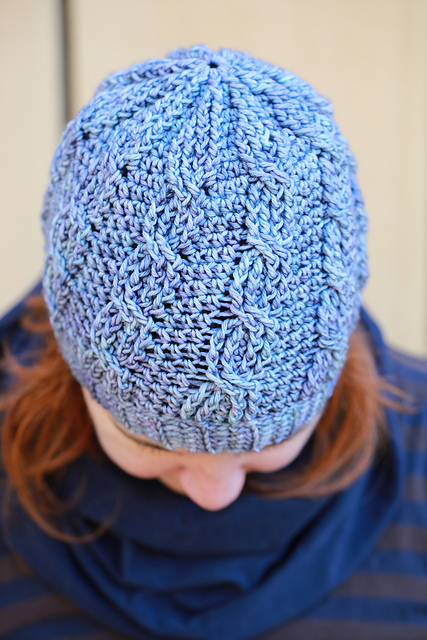
TWIST & SHOUT: CABLED CROCHET
Cal Patch | 3 hours
Cables aren’t just for knitters! We will explore various kinds of crocheted cables with a sampler of practice stitches, and then begin a hat or cowl. Knowing how to work with cables will add a whole new dimension to your crochet practice!
Skill level: Advanced beginner. Students must know their basic crochet stitches: Chain, Single and DOuble Crochet, and be comfortable using them.
SUPPLIES:
YARN: DK or Worsted/Aran weight, about 180 yds.
HOOKS: for DK: H/5mm for body of hat, G/4.5mm for rib, or size to obtain gauge for Worsted/Aran: J/5.75mm for body of hat, I/5.25mm for rib, or size to obtain gauge
Tapestry needle
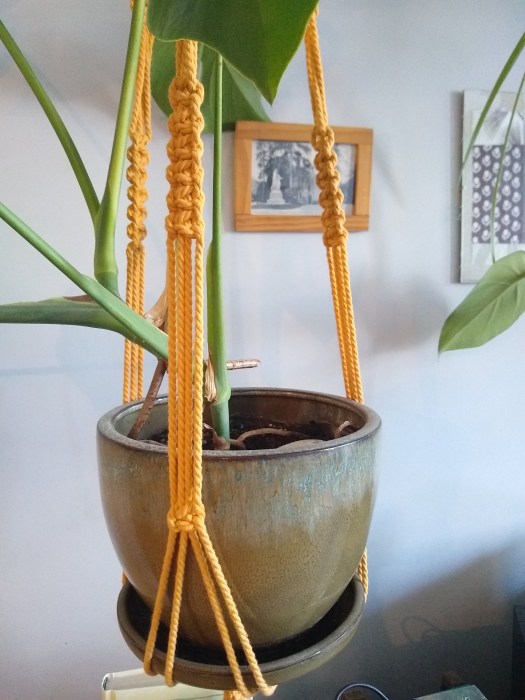
MACRAME PLANT HANGERS
Casey Ryder | 3 hours
House plants, house plants in the air! House plants, house plants everywhere! Plant hangers are a great introduction to macrame knots and they make for a sweet gift to your green buddies. We’ll start off by learning some basic knots while making camp bracelets. (It’s all coming back to me now!) Then we’ll hop on over to knotting with larger cotton cord and make a full size plant hanger.
No previous macrame experience is required.
Materials Fee: $15
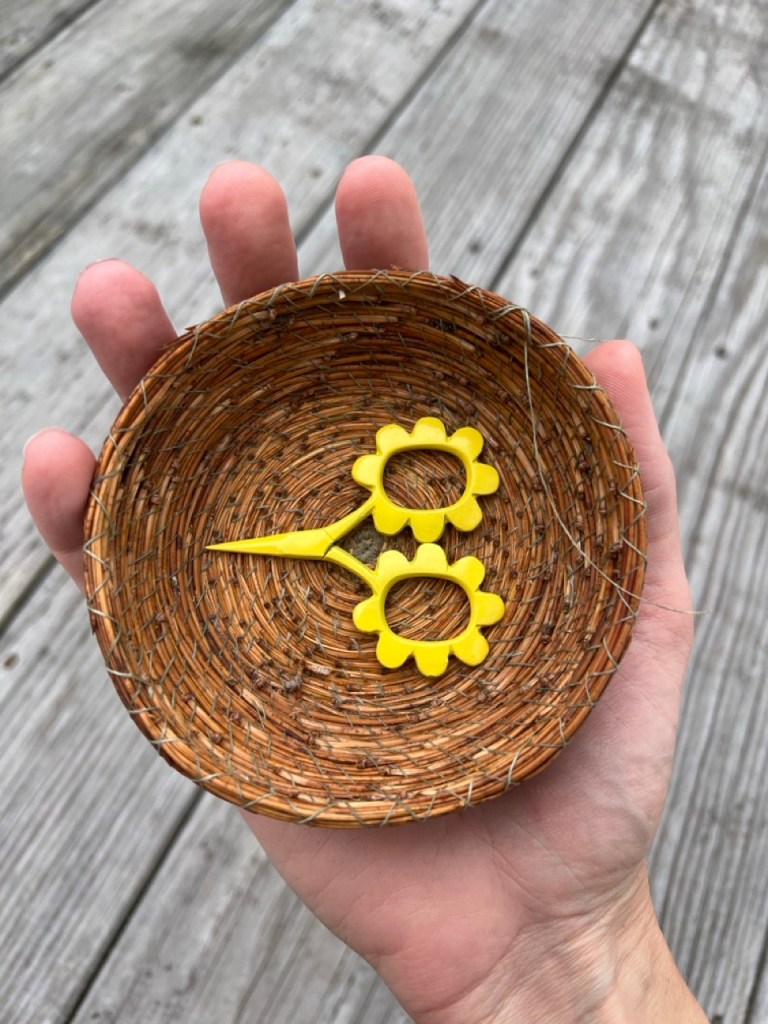
PINE NEEDLE BASKETS
Casey Ryder | 6 hours over 2 days
Coil baskets have a rich history having been made around the world by indigenous people, often using similar techniques. In this class, we will use pine needles as our core “fibers,” and waxed linen or synthetic “sinew” as the stitching thread. You will learn different stitch techniques as a means of function as well as design. You’ll have enough time to finish a wee vessel!
Materials fee: $10
PORTUGUESE KNITTING
Casey Ryder | 4 hours
Learn to knit with your thumbs! And when I say knit, I mean purl…
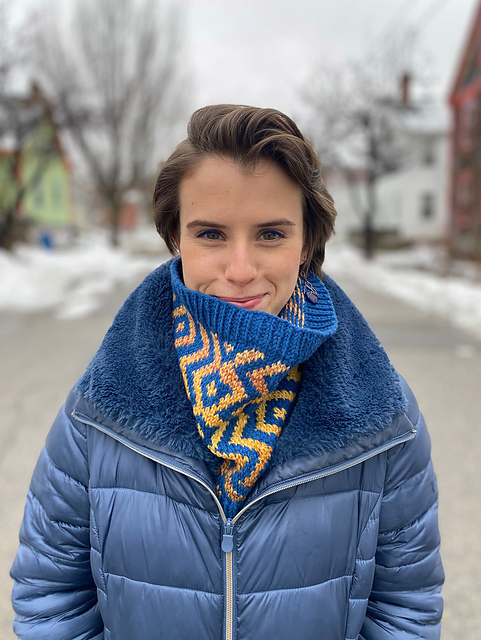
Portuguese knitting is a great technique for colorwork. The fabric is formed with the wrong side facing out and with the yarns tensioned around “knitting pins” attached to your shirt. Instead of picking or throwing the yarn, you will be using your thumbs to create purl stitches. It’s a different way to knit, but this technique is worth learning! Using this technique, floats travel along the outside of the fabric, making them less likely to be worked too tightly – an often frustrating result when knitting colorwork.
We’ll start by working a swatch and then we’ll cast on for a Cushing Cowl (pattern and photo below by Mary Jane Mucklestone).
Please bring:
16” US 8 circulars
Yarn can be provided or you may bring two contrasting colors of worsted weight yarn – Main color – 165 yards, Contrasting Color – 90 yards
Fee: $18 for the printed pattern with Ravelry download + Portuguese Knitting Pins
Yarn Kit 1: $38 for two contrasting colors of Highland, pre-wound into balls
Yarn Kit 2: $57 for one skein of Highland and one skein of Dream State, pre-wound into balls
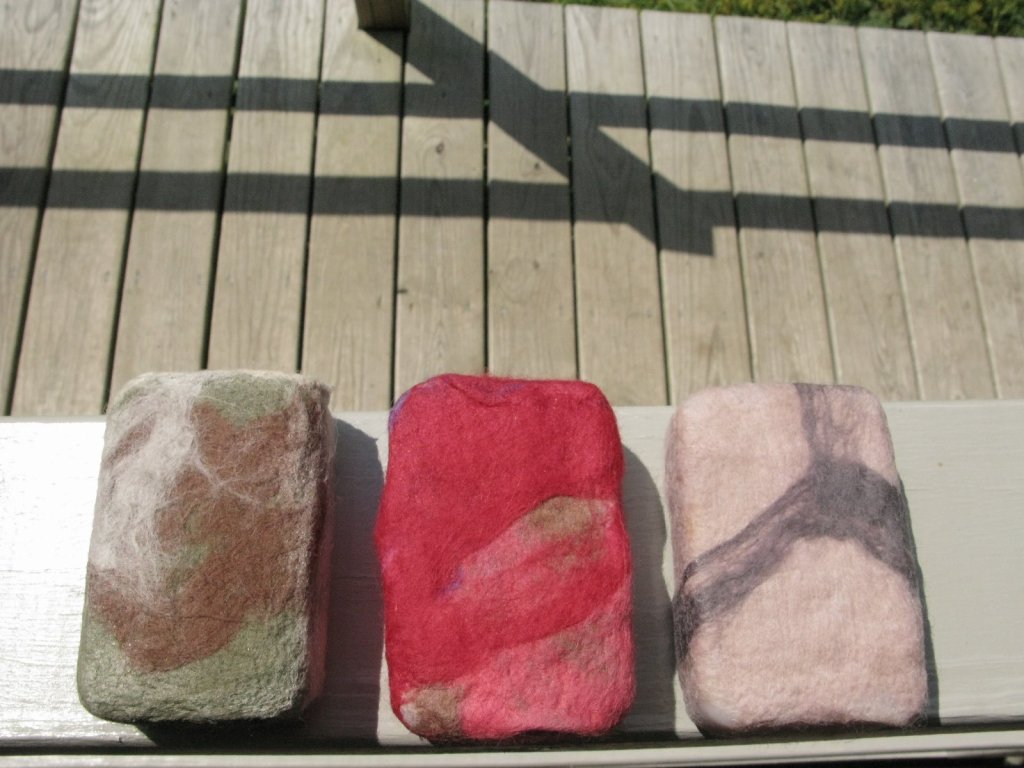
FELTED SOAPS
Casey Ryder | 2 hours
In this most basic wet-felting class, we’ll use Maine-made soap, wool roving, hot water, and a bit of friction to create wooly loofahs! Felted soaps are fun and easy and make great gifts or to treat yourself.
Expect to get sudsy and maybe a lil’ wet in this fun and laid back workshop.
Materials Fee: $10
MINI DIY LOOM WOVEN POUCH
Sarah Sockbeson | 6 hours
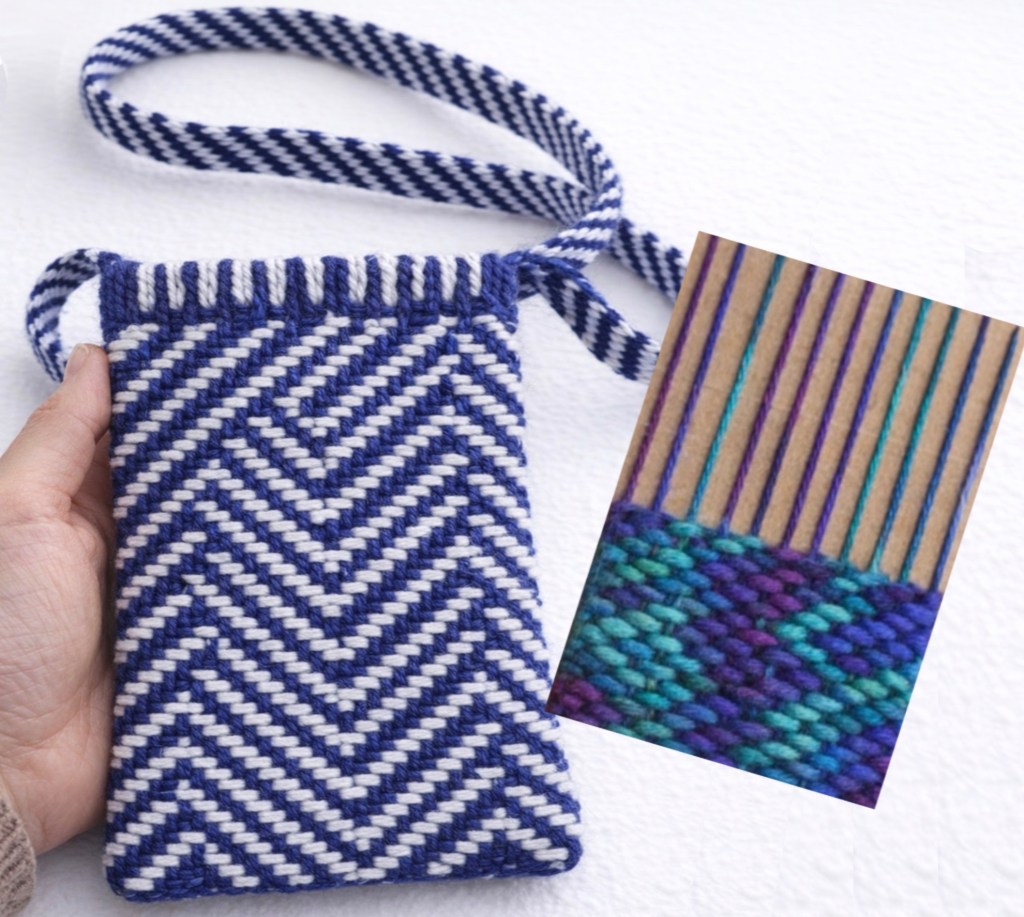
In this introductory weaving class, Sarah will teach you how to warp and weave on a small loom DIY loom. Using the materials provided, you’ll create from scratch a functional textile pouch. In the first session, you’ll learn basic weaving techniques, create your own loom, explore color and texture using a variety of yarns and fibers. In the second session weave and finish your piece, creating a small pouch. Optional embellishments such as fringe, beadwork, or decorative stitching a strap or closure allow you to personalize your design.
This class is designed for beginners and returning students alike. You will leave with a completed pouch and the skills to continue weaving such items on your own.
Materials fee: $20
REED BERRY BASKET
Sarah Sockbeson | 6 hour
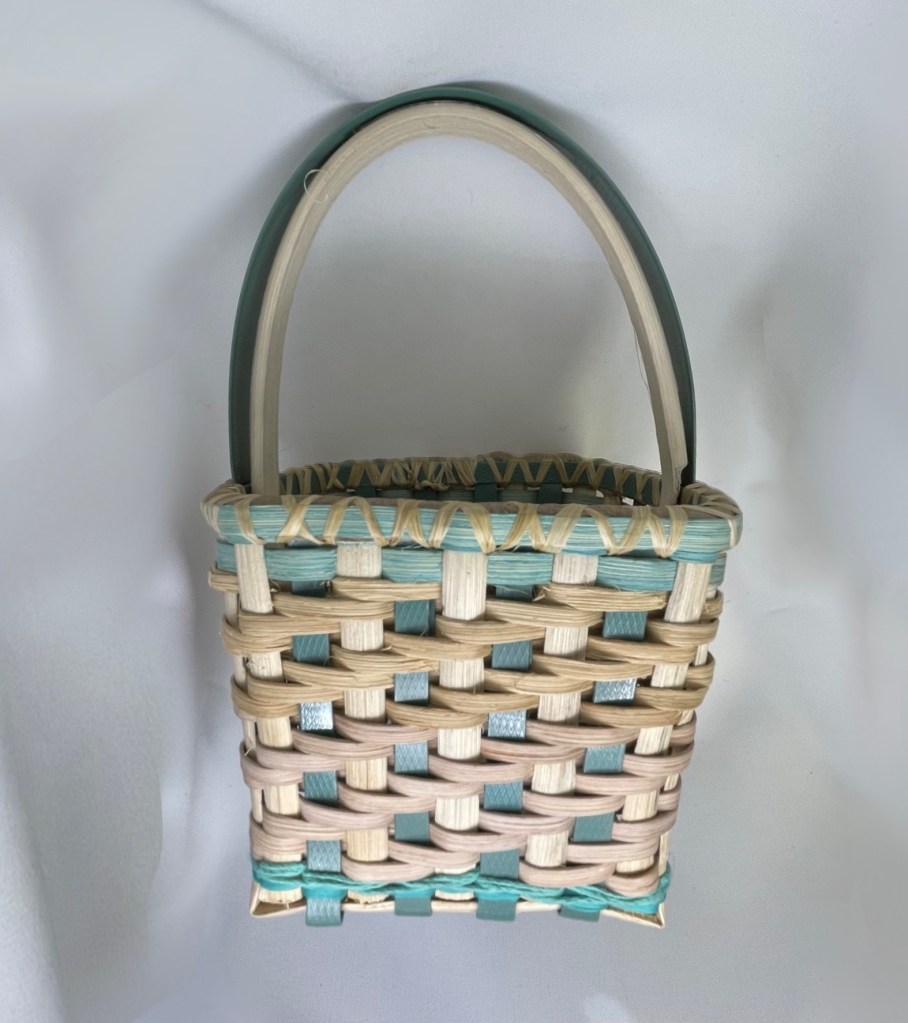
In this workshop, award winning Penobscot Ash and Sweetgrass Basketmaker Sarah Sockbeson will teach you how to weave a traditional berry basket using reed. You will learn how to prepare and shape reed, create a sturdy base, weave the walls, and finish the rim. Students may choose to add a handle or decorative elements depending on their design preferences. This is a great class for beginners or anyone wanting to learn foundational basketry skills. You will leave with a functional berry basket ready for everyday use.
Materials fee: $20
ROPE & YARN COIL BASKET
Sarah Sockbeson | 5 hours
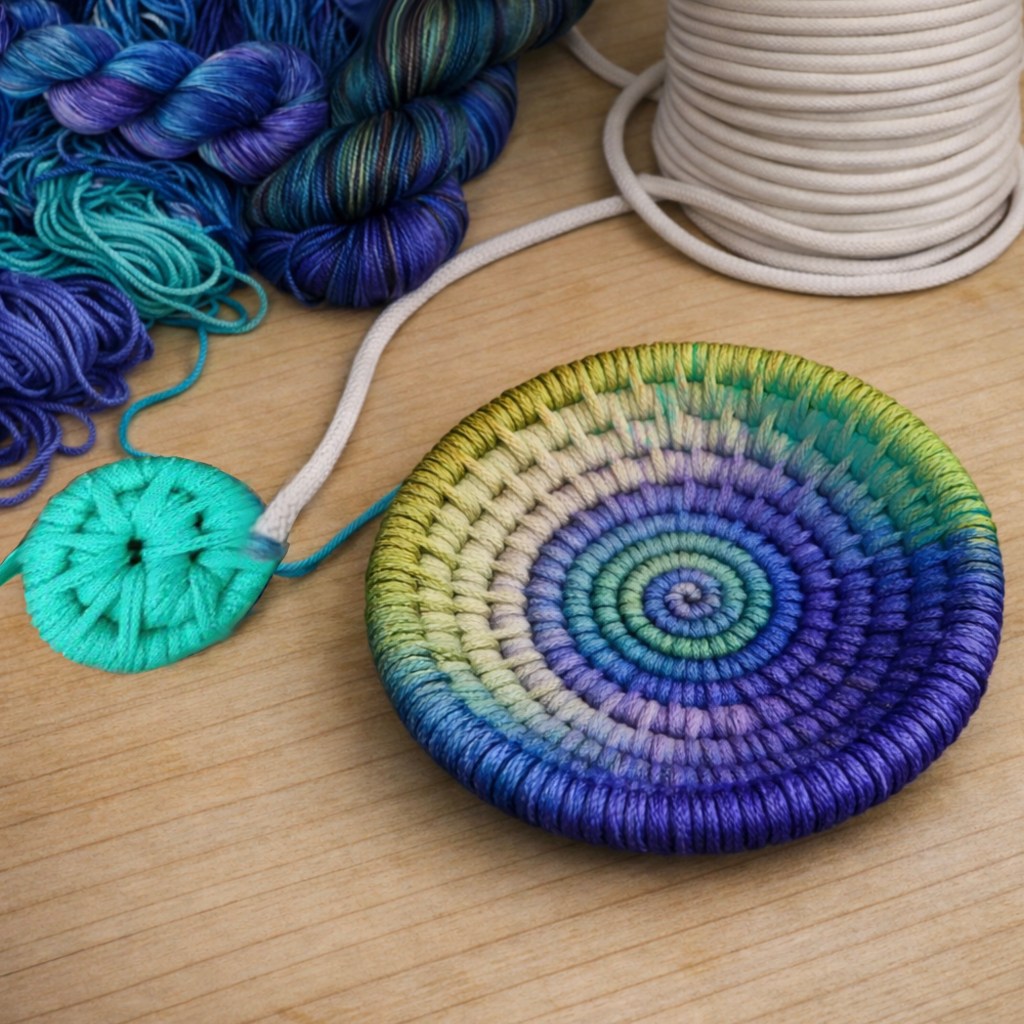
In this introduction to weaving class, you will learn the fundamentals of coiled basketry using rope, or reed, yarn, and other soft fibers along with more structured materials. Sarah will demonstrate coiling, stitching, shaping, and color‑transition techniques, and then you’ll design and create a basket of your own. Students may choose to make a small bowl, vessel, or sculptural form. This is a beginner‑friendly class with lots of room for personalization.
Materials fee: $20
NOTE FROM SARAH RE: SUPPLIES + MATERIALS:
I will bring a large assortment of materials, creating a communal pile for all of my classes. You are encouraged to bring your own materials as well, from the suggested list below, both for use in your own projects and to contribute to the communal pile.
Unless otherwise noted, fee is $20 to access communal pile.
The hope is to encourage the use of supplies that you are drawn to within the available options, to utilize and incorporate what you like/ what catches your eye, with the primary goal of allowing your imagination to lead your process, allowing the materials to guide you and opening the door through trial and error and experimentation. If one material doesn’t work, try another, or swap out one material for another depending on what works in your design and keep an open mind when developing your desired outcome.
If you choose to bring your own materials, I would strongly suggest everyone try to bring materials that don’t cost you anything, whether that be because you make/ produce the supplies personally, or because you gathered harvested it from nature/ processed or unprocessed as your contribution, or bring a form of supplies that you have no other use for/ have had on hand forever/ have never had the chance to utilize, or something that would be otherwise destined for the garbage or a recycling center (ideas listed below).
Note for anyone bringing freshly gathered/ natural materials:
Feel free to bring materials from any part of the country, just as long as it has been deemed “safe” to travel / treated in such a manner that it has no potential to contain any type of insect, disease or parasite. Invasive plants and insects are a known threat to native plant/ animals/ insect/human populations/ and our ecosystem as a whole, so please be mindful of proper harvesting practices, and avoid moving anything that could contain parasites or insects across state lines.
SUPPLIES (Suggested options):
This list is not meant to limit your imagination, but to provide possible suggestions of what may be a great contribution to our materials selection for any of my workshops
- wood veneer sheets or strips or edge banding wood, plastic, or other
- any type of yarn, cordage, rope
- wire, any type/ gauge, including recycled old wires, cords or cables, coated or not, wire coat hangers
- heavy weight paper, wallpaper, any type of thick paper, card stock, vinyl, watercolor paper, folders, document holders (plastic or paper)
- sticks, branches, willow, reed, bark, root, grass, flax, pine needles, yucca, palm fronds any other type of fibrous natural harvested material leaves or renewable plant materials, prepared or not (the more flexible the better)
- plastic or composite that can be cut into strips or used as a rigid base material
- shopping bags of any kind, paper, plastic,
- old fabric scraps, (longer strips or pieces that can be cut or braided)
- any type of basketry or caning supplies
- any type of fiber you can think of or enjoy working with
Have fun using your imagination and pondering over the possibilities…
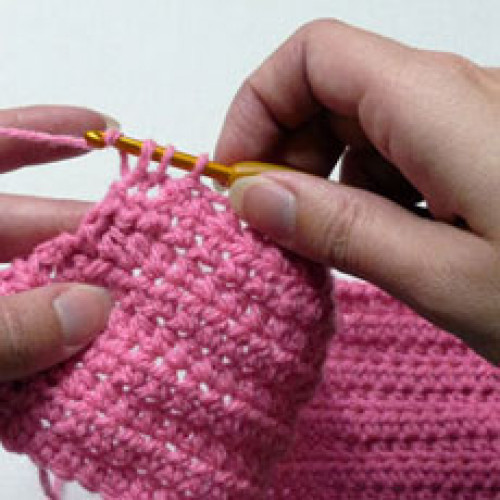
INTRO TO CROCHET
Bleu Vermeer | 3 Hours
Have you always wanted to learn to crochet but didn’t know where to begin? This relaxed, no-pressure class is the perfect place to start. In just three hours, we’ll demystify the basics and get you hooked!
You’ll learn how to make a slip knot, chain stitch, and the foundational stitches that are the building blocks of just about every project, as well as how to finish your work. This class is for absolute beginners and curious dabblers alike. If you’ve never touched a crochet hook before, you’re in the right place!
Materials Fee: $20
FROM FLUFF TO FORM: 3D NEEDLE FELTING BASICS
Bleu Vermeer | 3 Hours
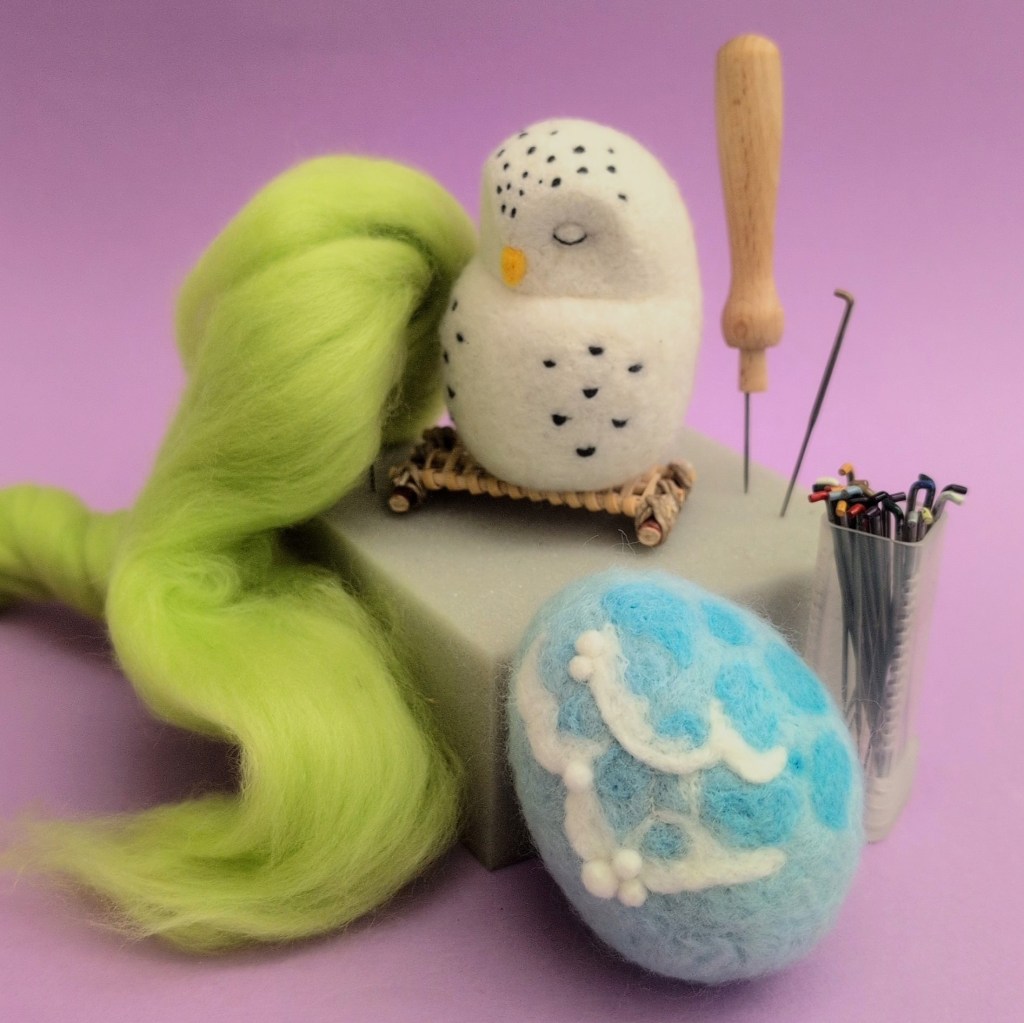
Needle felting opens up a world of soft sculpture—and this class will get you off to a confident start. In this skill-building class, you’ll learn how to create curves, corners, and points with control and intention. We’ll cover how to blend colors for natural shading, layer fiber for depth and detail, and securely attach separate pieces (like limbs or ears). Rather than focusing on a single finished object, students will leave with a series of sculpted samples that showcase their growing technique—great for reference and inspiration on future projects.
All materials and tools will be provided. Just bring your curiosity and a willingness to explore the possibilities of wool in three dimensions.
Materials Fee: $20
2D NEEDLE FELTING: PAINTING WITH WOOL
Bleu Vermeer | 3 hours
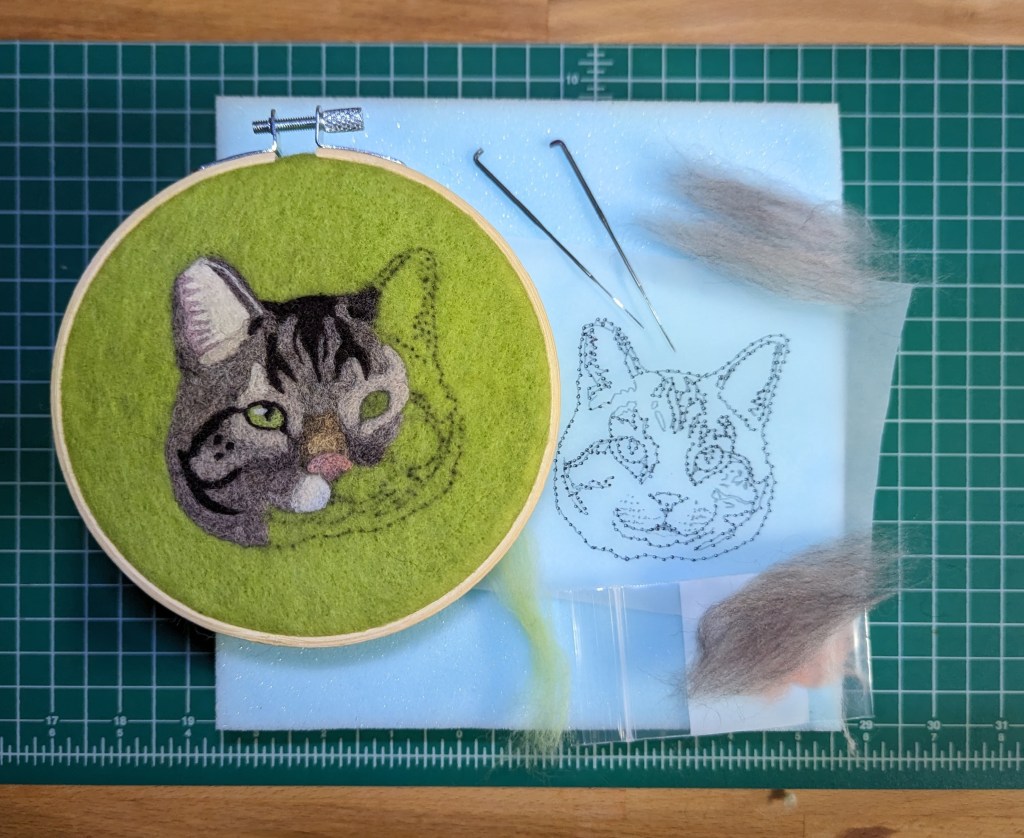
In this workshop, students will transform a favorite image into a small felted artwork. Using a photo or drawing as your guide, each student will recreate their design within a 4” × 4” square, building an image with layers of colorful wool fibers. We’ll begin by exploring techniques for sharp color transitions, soft gradients, and adding definition with crisp details like fine lines and small dots. Along the way, we’ll discuss controlling density and how to use fiber placement to achieve a painterly look with wool.
This class is suitable for beginners as well as anyone looking to refine their 2D needle felting technique. Students will leave with a finished miniature felted artwork and the skills and tools needed to continue creating felted images on their own.
Materials to bring : A print-out of a photo or drawing that can fit within a 4” × 4” square to use as their reference image. Simple compositions with clear shapes and colors work especially well. If you want to include writing, bring in a flipped version of the image (like you would see in a mirror). All other supplies and tools will be provided by the instructor.
Materials fee: $20
SPINDLE SPINNING BASICS
Bleu Vermeer | 3 Hours
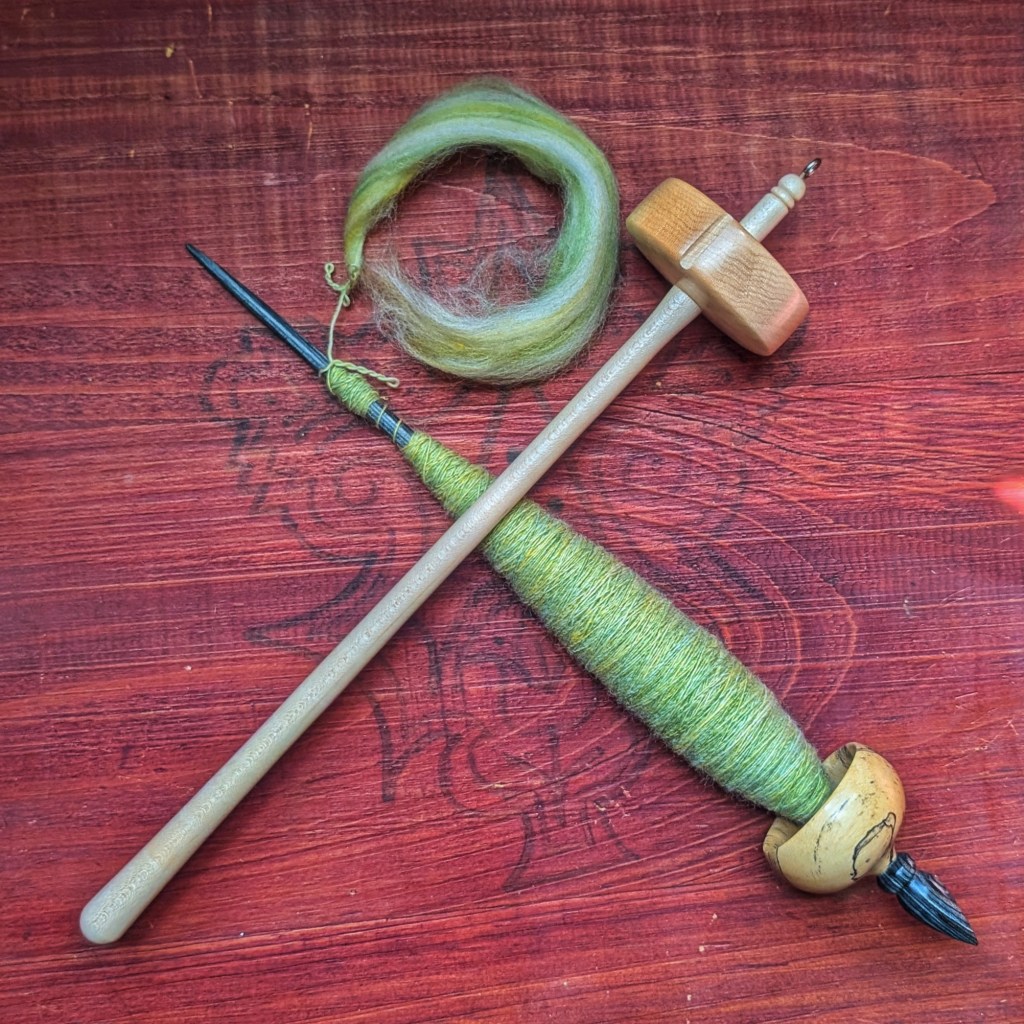
Learn the fundamentals of spinning with a spindle. Using your choice of a supported or suspended style spindle, we’ll break down the motions of spindle spinning step-by-step as we practice flicking the spindle, drafting fiber, and controlling twist. You’ll experiment with different drafting methods and try your hand at plying to create stronger, balanced yarn.
While the class focuses on the physical motions of spinning, we’ll also touch on topics such as fiber qualities, fiber preparation, and the possibilities of unusual yarns. Beginners are welcome, and spinners with some experience may enjoy refining their technique or exploring a different style of spindle spinning. Students are welcome to bring a spindle or fiber from home, but it is not required.
Materials fee: $15 includes fiber for spinning and rental of a spindle for the week.
 Medomak Fiberarts Retreat