
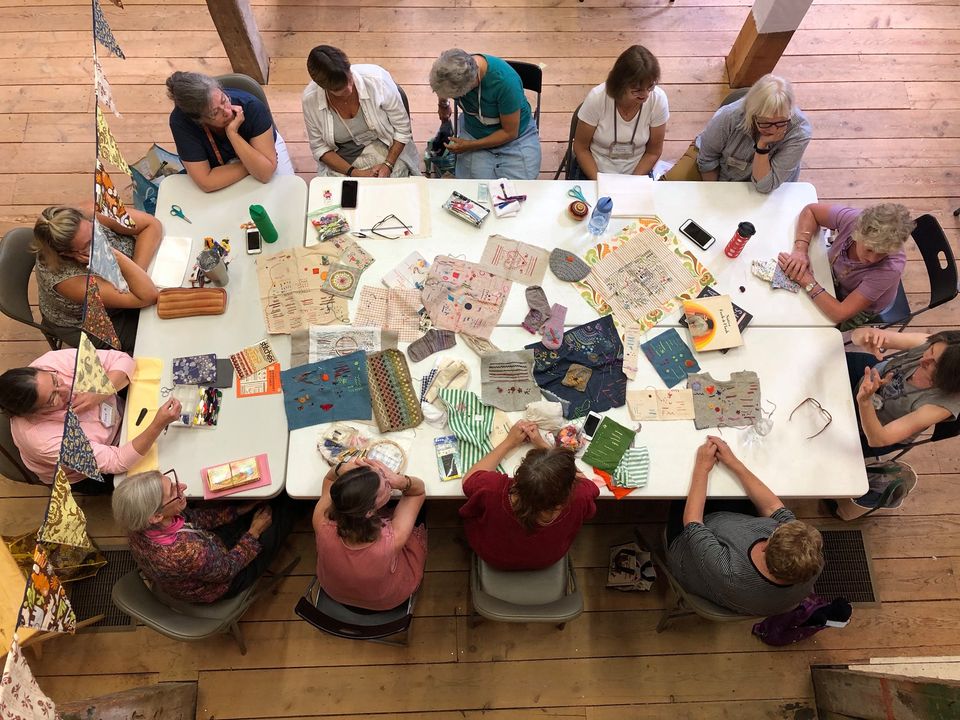
2026 classes will be posted soon! Below is a look at 2025, to give you a sense of the breadth of our offerings.
At the Medomak Fiberarts Retreat, you choose your own adventure!
You decide which classes you want to take based on your interests, level of experience, and how full you want your week to feel.
Campers can take up to 6 classes, with multi session classes counting as 1 class. This is so we can keep class sizes small, and also so you don’t burn out! Repeat attendees can attest to the benefits of building downtime into your schedule.
It’s important to note that many classes require significant time spent outside of class if you want to leave camp with a finished project, so keep this in mind as you think about how you want your week to feel. There’s nothing more peaceful and rejuvenating than knitting or stitching in a rocking chair on the porch or while listening to the loons down by the lake, so be sure to keep your schedule spacious if you want to include relaxing in to your week.
Signing up for classes happens online in May, once everyone has registered. Campers will make their 1st, 2nd and 3rd choices for each time slot and be notified of their schedule by mid June. Questions about this process? Reach out at medomakfiberartsretreat@gmail.com
Unless otherwise noted all classes are offered both weeks.
For those contemplating attending the retreat both weeks, rest assured there are are more than enough classes offered that you could take an entirely different set of classes each week and still not get to them all!
COLOR PLAY
Rachel Bingham-Kessler | 6 hrs
Spend a full day on just playing with color. Using prepped fibers, we’ll explore prepared natural pigment powders, freshly foraged plants and various eco printing techniques. Come away with your own color catalog of sample yarns and fabrics plus several eco printed tests of your work from the day. We’ll take the time at the end of class to insert all our samples into our booklets with labels. This will be a hands-on class where we will be checking dye pots often, sorting fresh plants, and covering a lot of ground with as many colors as we have time for. Bring rubber gloves if you wish but they are not necessary. Materials kit will include a prepared fibers pack & handmade booklet. No previous dyeing experience needed.
Materials fee: $20

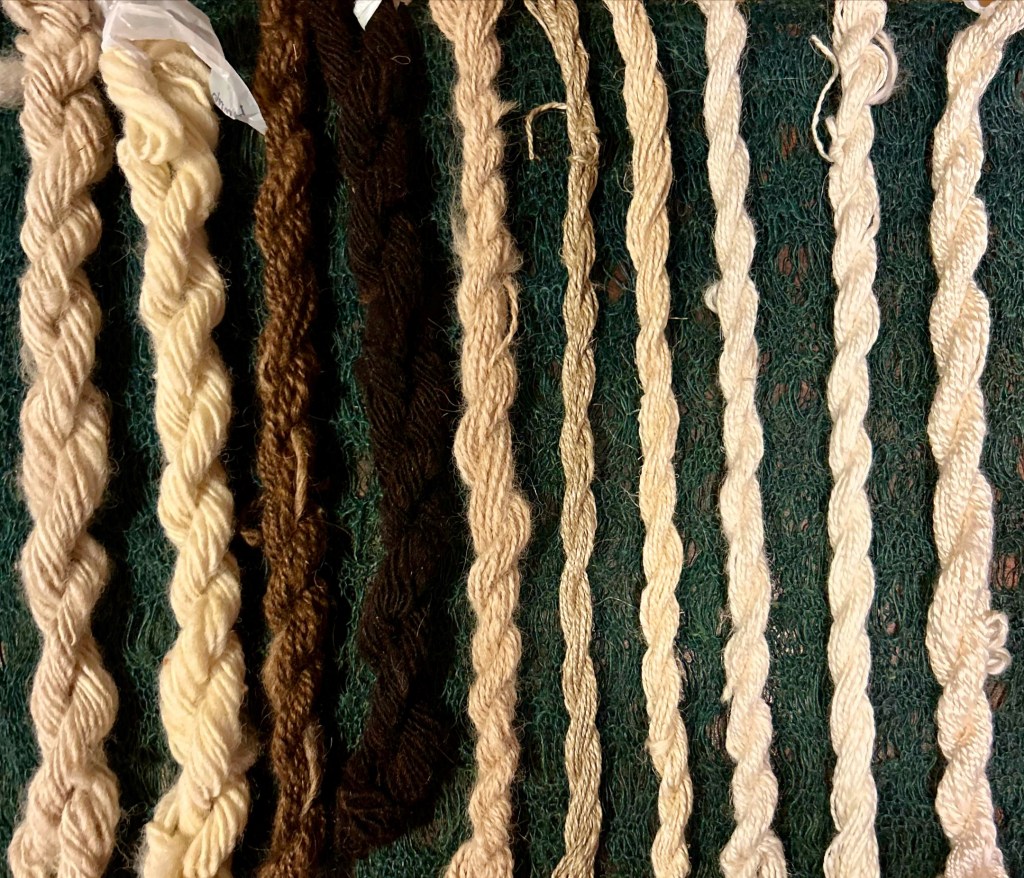
FIBER BUFFET FOR SPINNERS
Rachel Bingham-Kessler | 6 hrs
Spend the day at your wheel or with your spindle exploring the qualities of various fibers. We’ll work with a sample ranging from both protein and cellulose fibers while also sharing techniques for spinning each one. This is perfect for the very beginner of spinners to the well seasoned and everyone in between. I’ll provide a wide range fiber sample pack, which will be a wonderful opportunity to get or give help in spinning those trickier fibers with each other. As we spin up each fiber, I’ll share specs and stories, about how and where it’s grown and how it’s been used over time. You will receive a fiber sample pack & hand made booklet with sampler pocket to hold a sample of each of your spun yarns.
Experience necessary: Be comfortable using your wheel or drop spindle.
Bring: an apron or hand towel for your lap if you don’t want to end up super fury.
Materials fee: $20.
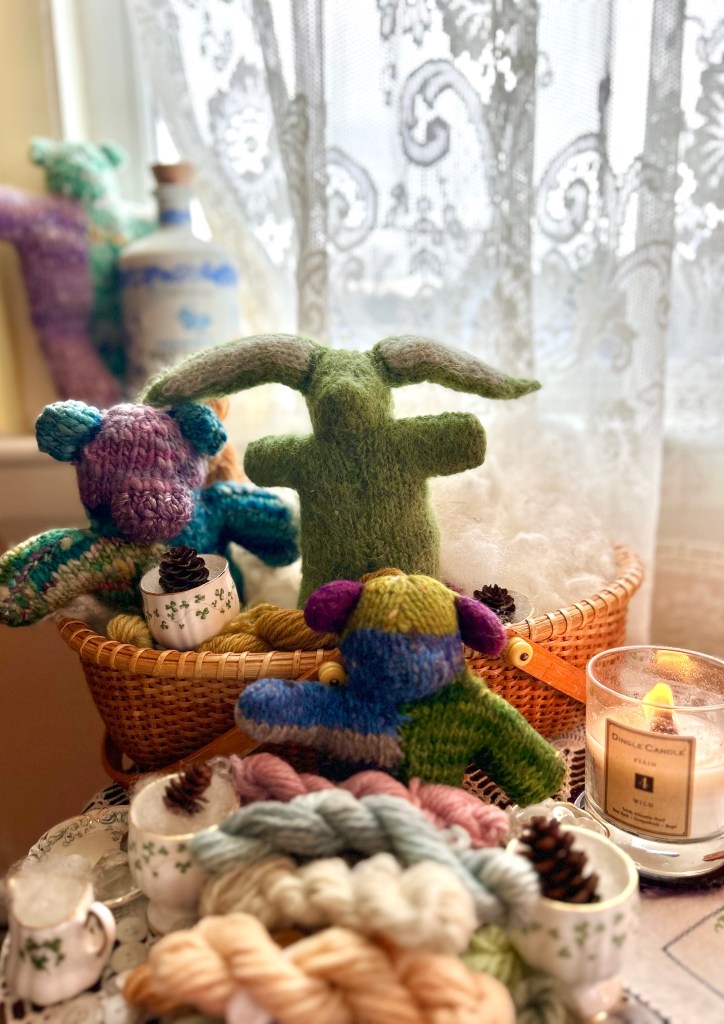
SCRAPPY BEARS
Rachel Bingham-Kessler | 3 hrs
Using any knitting needle size and any yarn you wish, knit up a quick and easy stuffed bear (or bunny!). This is a great project to do using up any scrap yarn as the stuffy always comes out with such a surprising personality. Rachel has been knitting these little (and sometimes giant) lovies for loved ones for 20 years. It’s a perfect project for beginners and advanced knitters alike. And a definite for finishing it at camp if you wish. The beauty of this knitted project is it can be any size you wish. You will be provided pattern and stuffing.
Experience necessary: Be comfortable with the knit & purl stitch, casting on & binding off.
Bring: any yarn- this can be in small scraps or all one color. Knitting needle to match the size of yarn. You’ll want a close knit for this project.
Materials fee: $10
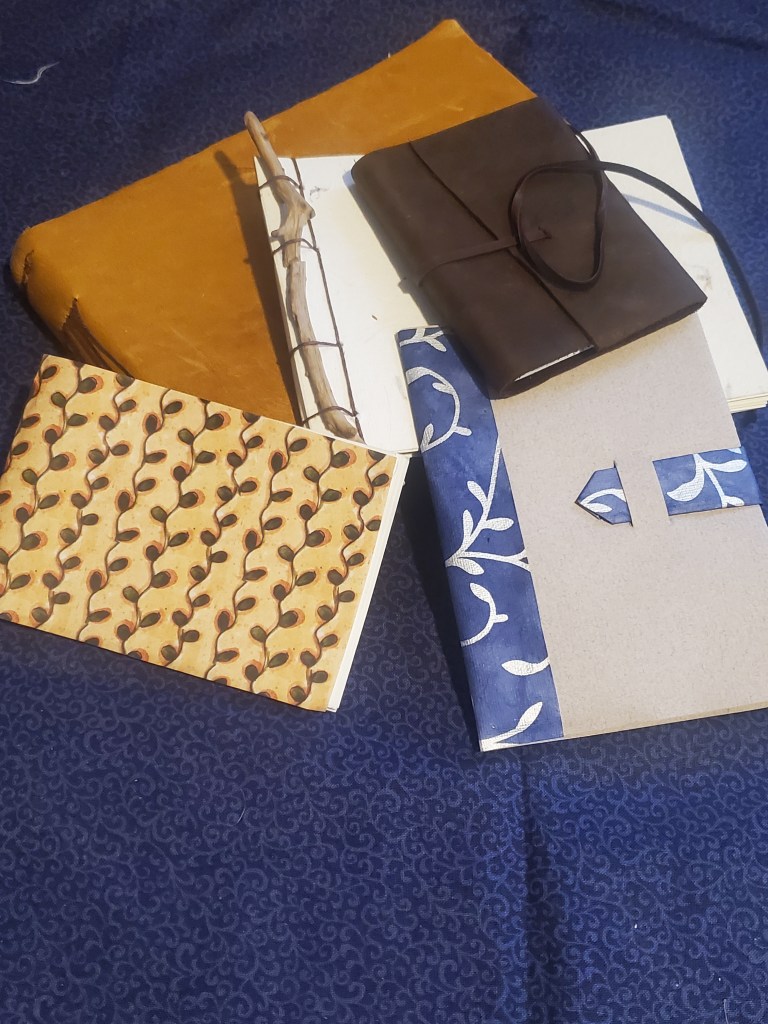
INTRODUCTION TO PAPERMAKING & BOOKBINDING 101
Cathi Belcher | 4 hours
This is an introductory class, designed for those who have NOT taken my class before. Hand Bookbinding is a slow, thoughtful process and an ancient art. In this 4-hour workshop, we will talk about handmade paper and have the opportunity to each make a sheet of paper which, when dry, will cover a small pamphlet. Most of the class will be spent creating a small leatherbound journal. Using quality paper we will sew 6 signatures together with waxed linen thread, and bind them with leather or cloth. No prior experience is necessary. There will be written instruction as well as in-person demonstrations for each step. Many other simple book forms (5 in all) will be taught, such as a small accordion book, pamphlet, Japanese Stab binding and a Zine.
Materials Fee: $25 includes paper, end boards, leather, bookbinding thread & use of needles, bone folder, awl, special glue, brush, razor knife. Copious handouts will be given so that you can continue to make books at home.
RADICAL SELF CARE FOR MAKERS: PRACTICES FOR A HEALTHY, HAPPY, BALANCED, AND CREATIVE LIFE
Cathi Belcher | 3 hours
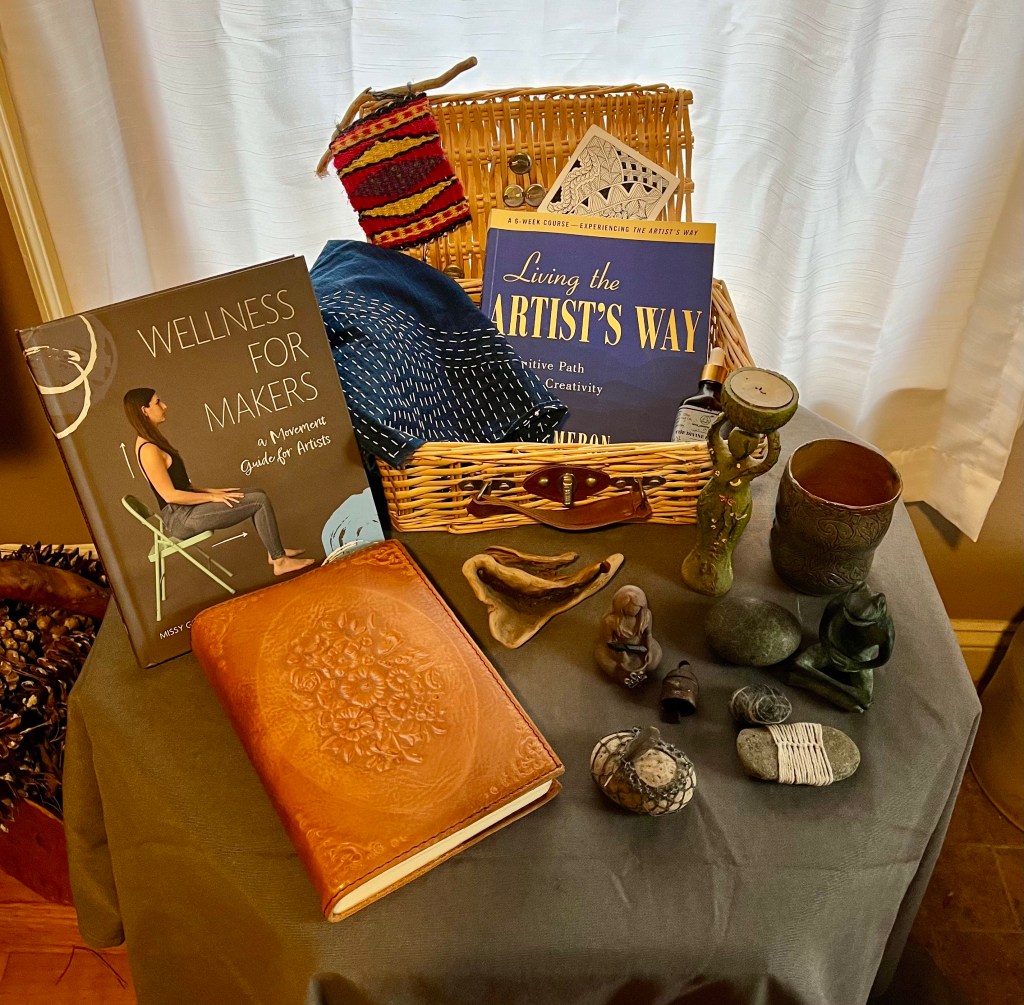
All too often, we have been conditioned to put others and their needs ahead of our own — from work, to community responsibilities, as well as friends and family. In this fun, informative hands-on workshop, you will be pampered and experience a veritable toolbox of artistic, practical and relaxing practices for a healthy, balanced and creative life. NO MEDICAL ADVICE WILL BE GIVEN, but you’ll be introduced to a variety of books, ideas and tools that saved Cathi, such as The Artist’s Way, relaxation techniques from Movement for Makers, and things like nurturing teas, essential oils, yummy nourishing snacks, musical playlists and much more. You will try your hand at a Japanese stitching technique called Sashiko and make a small Healing Meditation cloth to hang on your wall to remind you to B-R-E-A-T-H-E. You’ll learn the meditative form of drawing called Zentangle, and you’ll make a tiny peace flag for your garden. This is NOT a lecture; you’ll be participating in a patchwork sampler of hands-on self-care practices to stop destructive patterns in their tracks before our bodies get the chance to rebel!!
Materials Fee: $20.
WEAVING A LIFE: AN AMULET TO HOLD OUR INTENTIONS
Cathi Belcher | 3 hours
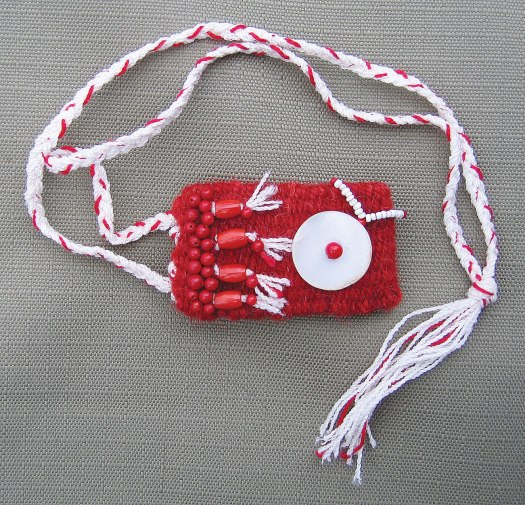
The Weaving a Life program, originally envisioned by Maine fiber artist Susan Barrett Merrill, can be approached on many levels, including an artistic journey of self discovery. The most basic, however, is simply handweaving beautiful & symbolic objects called Key forms on a small portable Journey Loom using tapestry and sculptural weaving techniques. All seven of these key forms are common to most cultures throughout the world, and can become manifestations of personal meaning for anyone who creates them. In this class Cathi will give a brief overview of the Weaving a Life program, and participants will weave an Amulet on a 7-stick journey loom. The amulet is a whimsical woven pouch we can wear like a necklace to hold our personal magic, innermost thoughts and small objects that hold particular meaning
for us.
No prior weaving experience is needed.
All tools and materials are included for use during class: the use of a 7-stick Journey Loom and tool kit, warp threads, weft yarn, beads and other
embellishments, as well as all written materials and handouts.
ROCK WRAPPING & WEAVING ON DRIFTWOOD
Cathi Belcher | 3 hours
If you love rocks, driftwood, knot tying and fiber – and enjoy the Zen-
like calm that comes when creating objects of art from nature … prepare
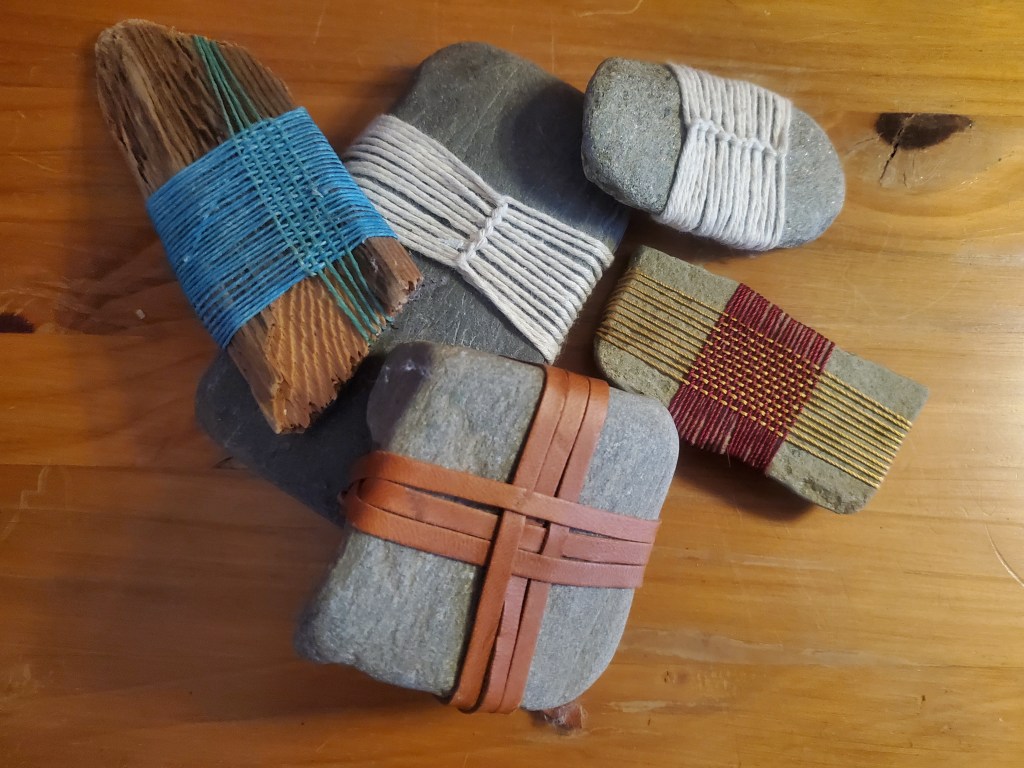
to be en’WRAP’tured! The beautiful art of rock wrapping has its roots in ancient Japan, using oval-shaped rocks wound with twine, leather or cordage. Using knot-tying and basketry techniques, the advanced art can be extraordinarily complicated, but beginner “rock-wrappers” can make gorgeous pieces of art that look complex but are deceptively simple. You will be amazed by your creations from your very first piece. Join ‘petro-phile’ Cathi Belcher, whose life-long love of rocks has led her to
this obsessive fiber-wrapped art. Rocks and driftwood will be provided, but ancient stones have their own unique energies and stories to share, so you are encouraged to bring 3-4 smooth, flat, oval-shaped rocks (about 3-5” long) that particularly speak to you, plus any small pieces of driftwood. Let’s get stoned and drift along in this fun 3-hour workshop!
Materials fee: $15.
COMMUNITY LOOM
Cathi Belcher | ongoing
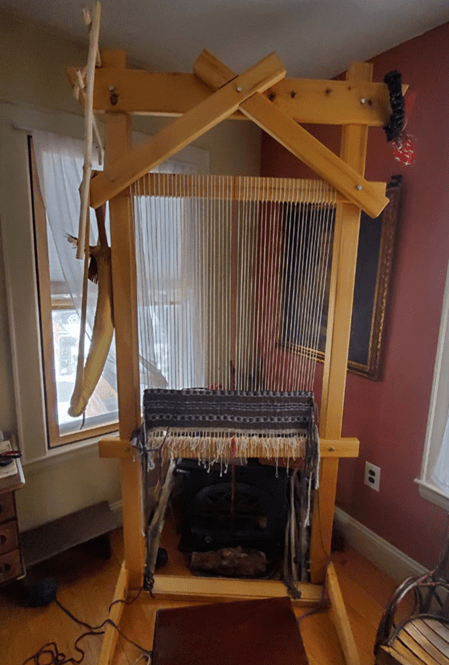
Earth Looms are floor to ceiling looms used in community and group weaving experiences, developed by Weaving a Life founder, Susan Barrett Merrill. Cathi Belcher will have her own 7’ loom, which she made herself of Alaskan yellow cedar, set up on the front porch of the Lodge during the week of Fiber Camp at Medomak. Everyone is invited to be a part of creating daily group tapestries by adding to, and weaving in your own unique threads and fabrics throughout the day. Cathi will curate the loom by taking off finished tapestries and re-warping it for the next one. Each wall hanging will be raffled off on the final night of camp, and proceeds will be donated to the Medomak Scholarship fund. This experience is open to all. You do not have to sign up to be a part of it, but feel free to bring your own materials, textures and embellishments to add your own personal touches. There will also be a communal basket of fibers and fabrics for everyone to use.
The Loom will be set up for weaving for both Week 1 and Week 2
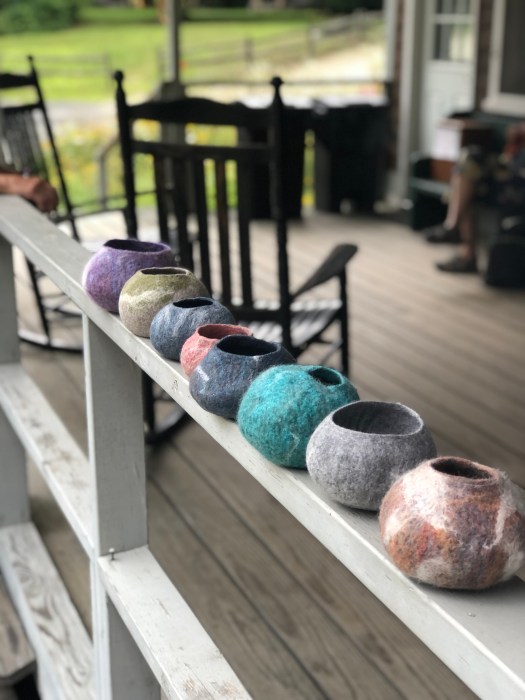
FRICTION & TRANSFORMATION: MAKING A FELTED VESSEL
Katherine Ferrier | 6 hrs
In this class we’ll learn the basics of wet felting to make a simple, seamless small bowl or vessel by transforming wispy wool roving into a durable structure using water, soap, and a bit of agitation. Along the way, we’ll marvel at the many metaphors of how things come into being, how friction helps new forms emerge, and how patience is a practice where transformation is concerned. No previous experience with felting necessary, but be prepared to break a sweat. Wet felting is very physical! Please bring 2 large, old towels, an apron and/or wear clothes you don’t mind getting a bit wet.
Materials fee: Kits will be provided for a fee of $20
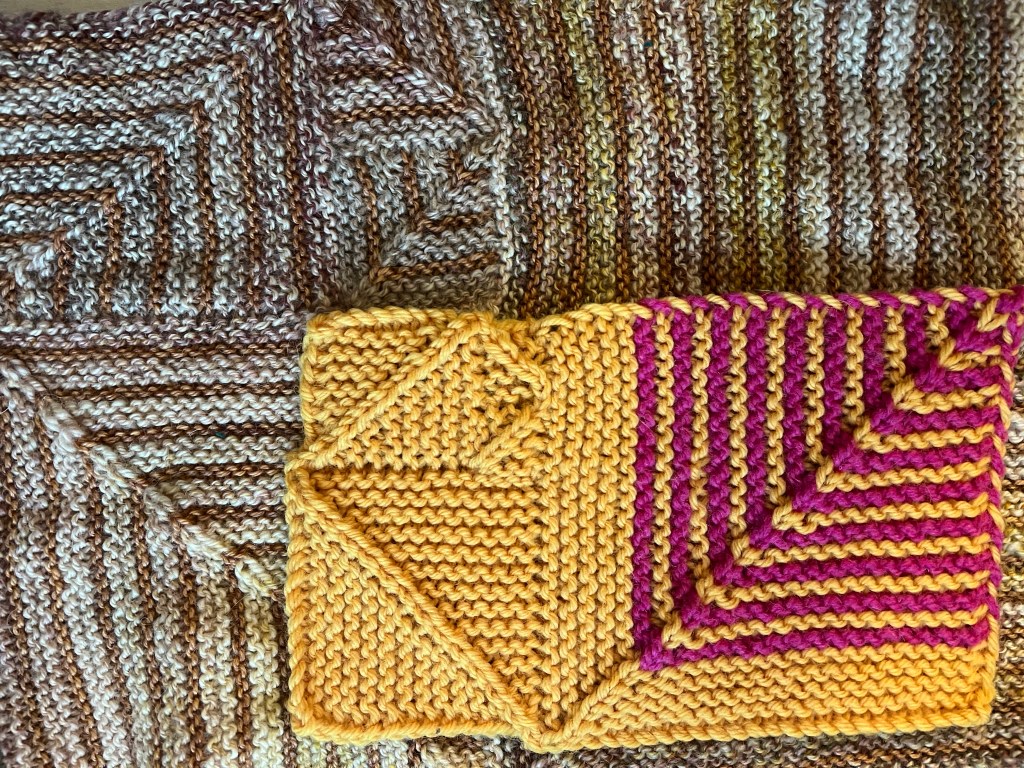
AS EASY AS 1, 1, 2, 3: FIBONACCI MITERED SQUARES
Bristol Ivy | 3 hrs
The Fibonacci sequence shows up everywhere, from math to nature to art. But did you know it’s also applicable to your knitting? In this class, we’ll use this formula in combination with a beloved and easy knitting technique to create one-of-a-kind mitered square pattern blocks you can use in blankets, scarves, garments—all without breaking your yarn once!
Skills needed: knitting, purling, decreasing
Please bring: pen or pencil for taking notes, 70 yards of smooth worsted weight yarn in a light color and size US 7 needles (either straight or circular) for learning the technique; please also bring a full skein of worsted weight yarn, already wound, for starting a larger project. If you have a small scale that can register grams or tenths of ounces, please bring that as well.
FIT THAT KNIT
Bristol Ivy | 3hrs
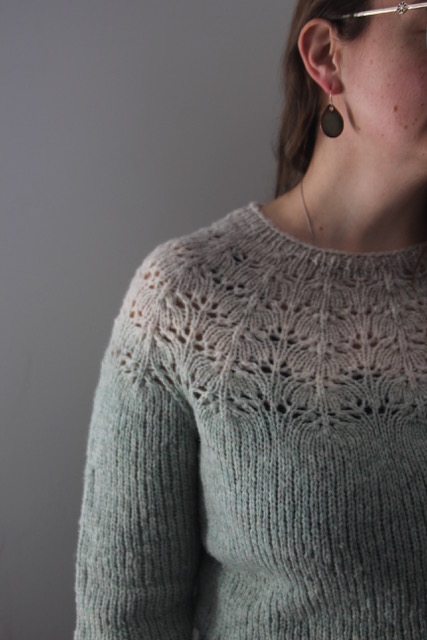
How do you pick a sweater size? How do you calculate positive ease? How about negative ease? And really, have you ever tried to measure your own bicep? Each of these tasks can be a stumbling block on the path to knitting your own garments. In this class, we’ll develop a comprehensive set of measurements for our own bodies that we can reference for future sweater knitting. In addition, we’ll talk about how we can use the sizing info included with patterns, and pick the perfect size to start knitting your new favorite sweater! Please note: this class will be based on body positivity. All sizes and shapes are welcome, and no self-criticism or shaming is allowed. All bodies are worthy of a well-fitting sweater!
Please wear: a comfortable t-shirt that fits snugly. This is also a perfect class to take with a buddy since we’ll be helping each other with our measurements!
Experience needed: comfort with making garments
Homework: none
Materials: a measuring tape, any garment patterns you are interested in knitting, and one or more of your favorite garments (hand knit or commercially made) that you love the fit of. Optional: a standalone calculator (most phones have built in calculators these days), writing implement for taking notes
BLOCKING 101
Bristol Ivy | 3 hours (over 2 days)
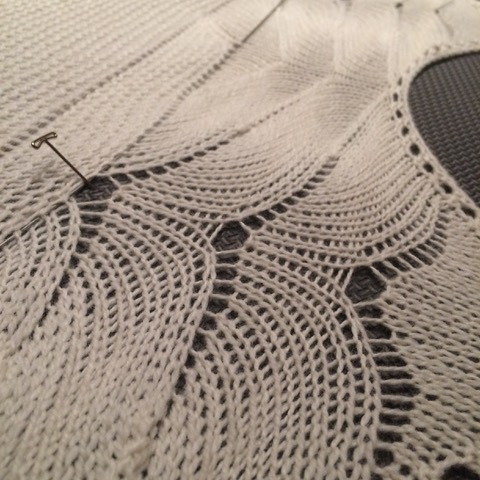
Most knitting patterns will finish up by saying “block to measurements”. But what does that mean? And should you steam block? Wet block? What about blocking lace versus blocking cables, or texture, or stockinette? Should you block before seaming or after? We’ll talk about different options for different fiber, garment, and fabric types, and then get some hands-on experience with blocking differ- ent swatches and some finished items.
Materials and homework: Students will be provided with a pattern for a lace swatch prior to class. Please bring that, worked in any yarn, and any project that you’d like to block. We’ll talk about your options!
A SLICE OF PI
Bristol Ivy | 6 hours (over two sessions)
Have you ever wanted to design a shawl of your very own? Pi shawls are the perfect canvas for exploration! Their structure means that we can be as adventurous as we want, from simple garter stitch to adding stitch patterns to changing the shape of the shawl altogether. Add this shape to your shawl repertoire today!
Experience needed: knitting, purling, increasing, interest in or ability to work with stitch patterns
Homework: none
Materials: please bring yarn wound and ready to go in the weight of your choice in the following amounts:
Fingering weight: 800 yards
Sport weight: 600 yards
Worsted weight: 500 yards
Bulky weight: 300 yards
The thicker the yarn, the more likely you are to finish your shawl while at camp, but go with your own personal preference!
Please also bring appropriate needles for the yarn you are choosing to work with. Stitch markers may also be helpful.

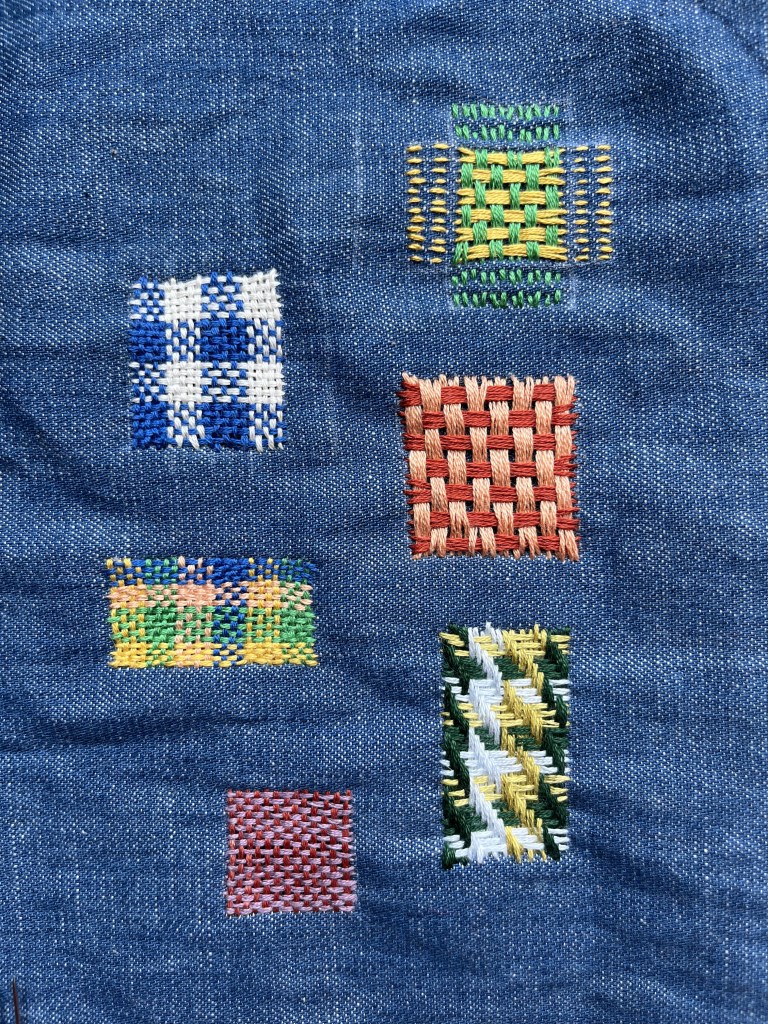
DARNING
Jessica Marquez | 4 hours
Darning or needle weaving creates a mini loom right on your fabric weaving together a magical fresh new material. This technique is great for covering stains, repairing holes, and reinforcing thinning fabrics, and can be used on many different types of fabrics. You will learn the basics of this versatile mending technique, and be guided through mending one of the items you bring. You will receive a supply kit full of my favorite go-to tools & materials including darning needles, thread, sewing pins, embroidery hoop, and a marking tool. You are welcome to bring an article of clothing (denim, canvas, linen, cotton, knit, jersey) to work on or practice the techniques on provided materials. All experience levels are welcome!
Class fee: $15
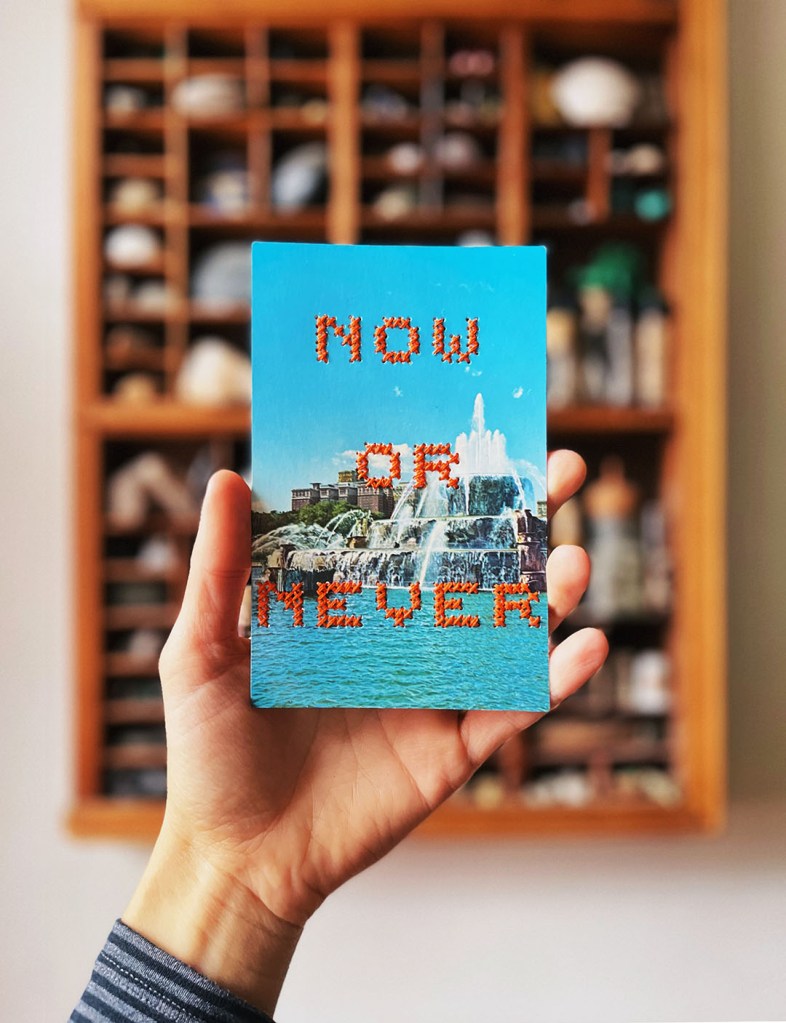
STITCHED POSTCARDS
Jessica Marquez | 3 hours
Inspired by my love of snail mail & all things stitch related we will make mail art or art objects from vintage postcards. Using postcards collected from travels and thrifting I’ll share different approaches to stitching on paper, embroidery stitches, transferring designs and share inspirations to help inspire your exploration. Postcards can even be mailed afterwards! Or keep them as artful reminders of your time at camp.
Materials fee: $15 includes vintage postcards and other ephemera, embroidery floss, awl, washi tape, graph paper.
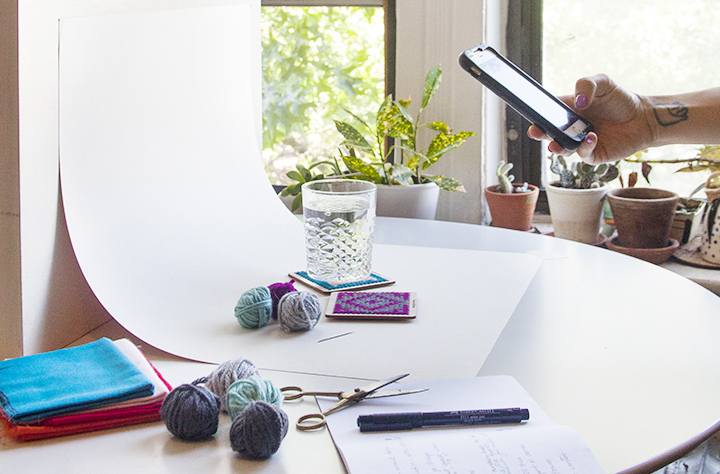
SMARTPHONE PHOTOGRAPHY FOR FIBER ARTISTS
Jessica Marquez | 3 hours
In this hands-on workshop students learn how to set up an inexpensive home studio to take high quality images using only the camera on their smartphone. This class is designed for textile artists who want to get the most out of their camera phone to be able to share their work quickly, and in the best light. Even if you just want to improve your daily shots there will be lots of basics and tips and tricks for improving images covered. Learn the basic elements of both photography and product photography, how to create a mobile home studio using daylight, helpful and inexpensive tools to improve image quality, and how to edit photographs with apps. This is a hands-on workshop where you will have a chance to practice and explore the techniques covered in class. Bring your work to photograph, and smart phone in hand.
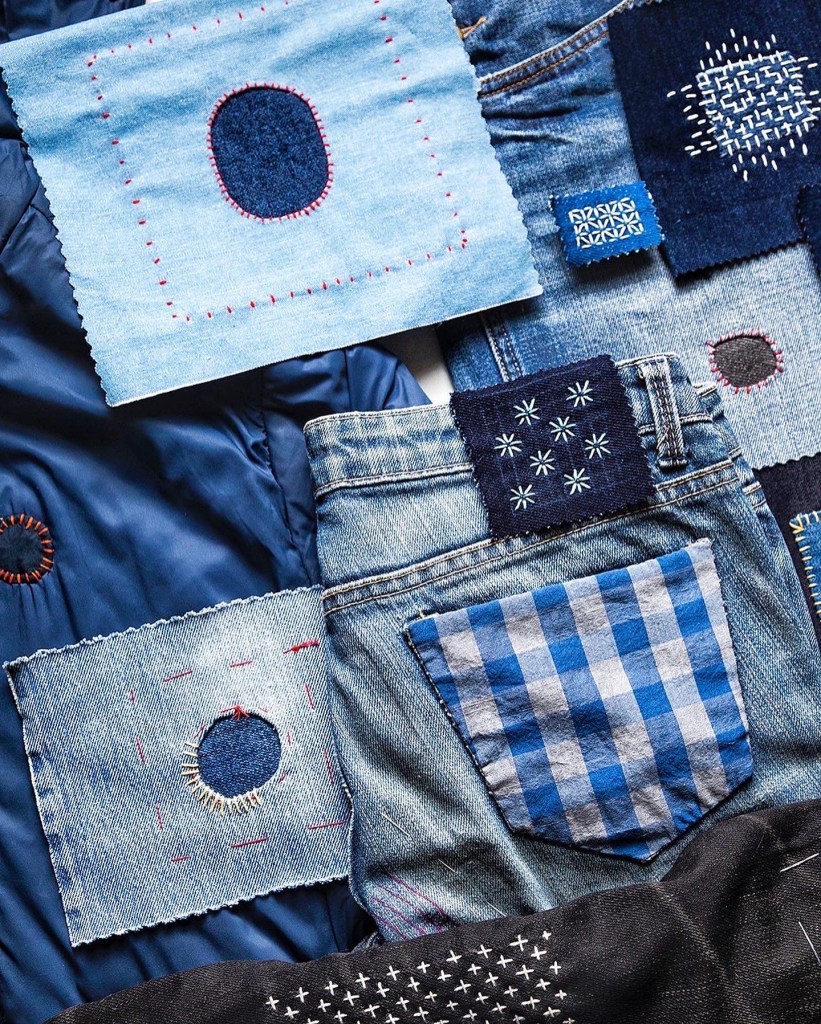
THE ART OF THE PATCH: REPAIRING DENIM
Jessica Marquez | 3 hours
Denim repair is one of the easiest ways to dip your toes into mending. We will cover the basics of patching and stitching by hand. These simple techniques not only prolong the life of your clothes but are also super satisfying and meditative. You will receive a supply kit full of my favorite go-to tools & materials including: sashiko needles, sashiko thread, ruler, marking tool, sewing pins, and upcycled denim fabric for patching and practicing. Bring your favorite article of denim clothing (or similar fabric) in need of mending to work on or practice the techniques on provided materials. All experience levels are welcome.
Class fee: $20, and includes: sashiko needles, sashiko thread, ruler, marking tool, sewing pins, and upcycled denim fabric for patching and practicing
STITCH RESIST SHIBORI
Jessica Marquez | 4 hours
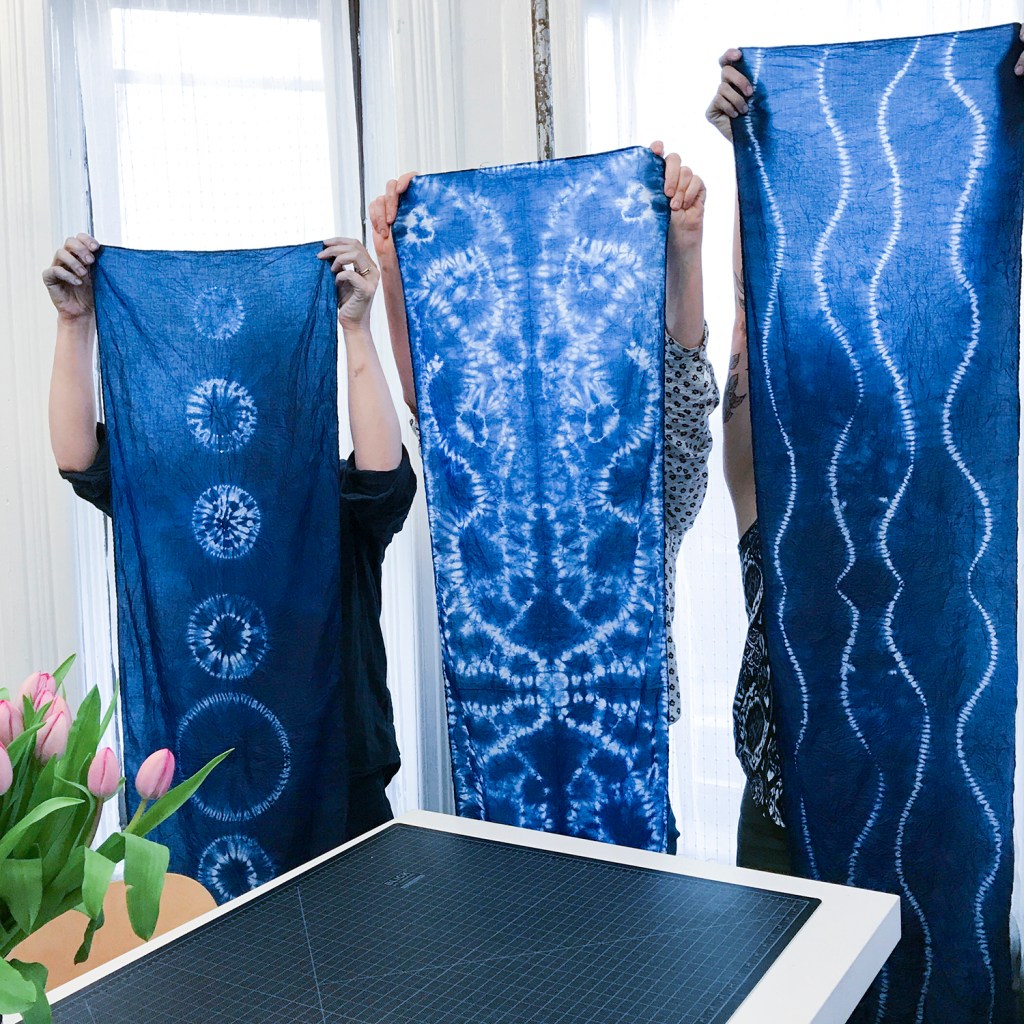
The Japanese art of shibori uses folds, twists, ties, and even stitches in fabric to create patterns with dye. Stitch resists are particularly interesting to play with, because you can create intricate, detailed patterns, even text, with the organic look of shibori. Students will learn several stitching techniques, how to layout a repeat pattern, prep materials for dye and dye their own one-of-a-kind indigo piece. Students will be provided with cotton scarves and bandannas to dye, but can also get creative using their own clothing. No experience needed: beginners welcome!
Class fee: $25 includes: indigo dye, cotton blank, sashiko needles, drawing tool, button craft thread, and seam ripper.
HAND STITCHED T-SHIRT
Cal Patch | (6 hours over 3 days)
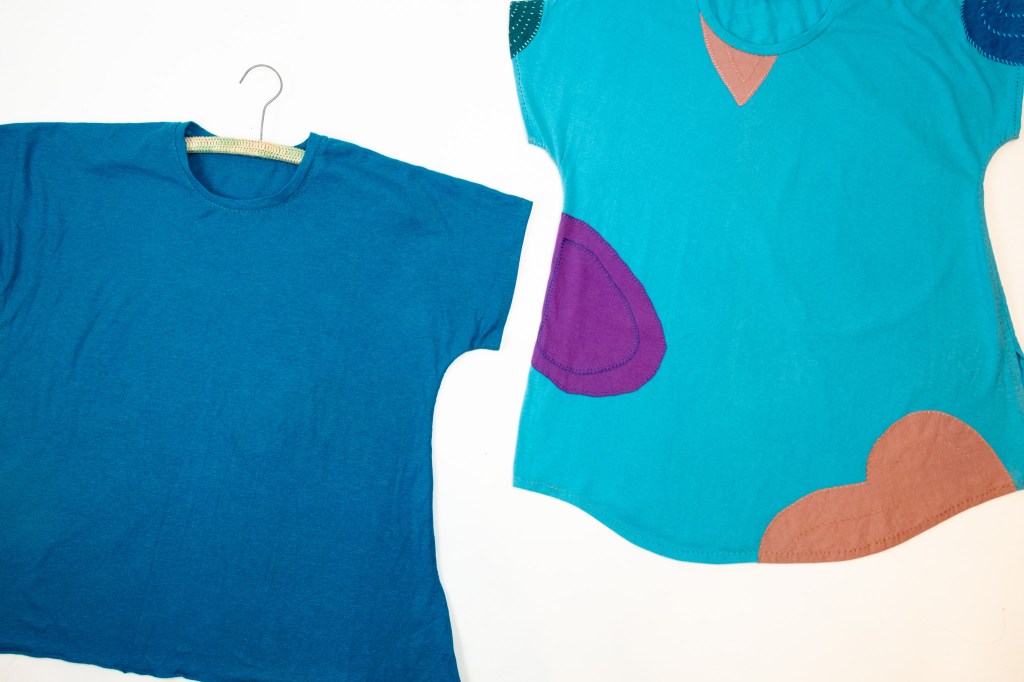
Sewing on a machine is quick and practical, but for many it’s difficult to find the dedicated time and space required to make it a regular habit. Moving your sewing practice into the realm of handwork (like knitting, crochet, and embroidery) means you can stitch up garments whenever you have a few spare minutes, or on the couch at night while watching a movie, and carry a project with you so you always have it on the go. Sewing by hand adds an element of meditative calm to your sewing practice. Amazingly, you might find you can finish a hand-sewn garment sooner than a machine-sewn one!
We will work with a pattern (see supply list for options) for a simple, knit T- shirt and learn how to sew seams, finish necklines and hem edges with only your hands and a needle and thread. Several methods for each type of seam will be shown, so you may also create a sampler of extra techniques.
No prerequisite skills, though an understanding of basic sewing principles will be helpful. You will need to have your pieces (front and back only, skip any facings) cut out before start of class.
Supplies needed:
— Pattern for simple t-shirt (see list below)
— Fabric: light-to-medium weight cotton jersey or interlock knit fabric. Quantity as indicated for your size* on pattern, but 2 yards is probably
sufficient for most. Solid, print or stripes, your choice!
— Front and Back pieces (and sleeves if pattern has them) ALREADY CUT OUT of your fabric (no need for any facings included in pattern). Please use simplest version with no added seams, unless you don’t mind extra homework.
— Fat quarter or approximately 12-18” square (smaller is fine) of similar or
same fabric (could be a scrap left over after cutting) for sampler
— All-purpose thread, can be contrast (to see your stitches) or matching
and/or size 8 Perle Cotton
— Hand-sewing needles in a few sizes, or your favorite size
— Pins
— Scissors
— Marking tool (chalk, wax or pencil) and ruler
— Optional: Thimble
Please use one of the following patterns, or a similar T-shirt or boxy top:
— Boxy Tee/Drapy Tunic, OR T-Shirt pattern, drafted in a previous class with Cal, or from her online video class, or tutorial found on her website (for boxy tee only). (NOTE: please just do the simple version without the seam and pocket)
https://calpatch.com
— Jade T-shirt
https://shop.made-by-rae.com/collections/knits/products/jade
— Lou Box Top
https://www.sewdiy.com/shop/lou-box-top-pdf-pattern
— Fen Top*
https://fancytigercrafts.com/products/fen-pdf-pattern
— All Well Box Top**
https://www.etsy.com/listing/713038843/all-well-box-
top-sewing-pattern-hacking
— Shirt No. 1**
https://shop.100actsofsewing.com/products/100-acts-of-
sewing-shirt-no-1-sewing-pattern
**These are loose-fitting tops, meant for woven fabrics, so they have some ease built in. so you may wish to choose a size or two smaller than called for according to your measurements, for a more fitted t-shirt. If you are very concerned about a perfect fit, you may wish to machine-stitch a muslin/fit sample first, or baste your cut pieces, to confirm size.
CROCHET ON THE EDGE
Cal Patch | 3 hrs
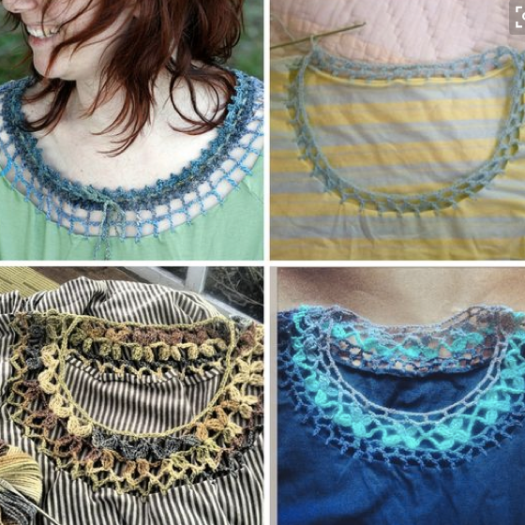
Adding a crocheted yoke to the neckline of a T-shirt is a stunning way to upcycle, or make from scratch, unique and gorgeous garments! You will learn several ways to work directly into the edge, and then experiment with different crochet stitches to design your own statement piece. Students must be comfortable with the basic stitches (at least ch, sc and dc).
Supplies:
*Assorted scrap yarns to play with (fingering/sock is a great size)
*Compatible hooks (smaller steel hooks are great if you have them)
*Scrap of t-shirt or knit fabric to practice on
*Old T-shirt that needs a makeover
*Tapestry needle (a slightly smaller needle can also be helpful)
*Scissors
PIECE OUT: PATCHWORK BOXY TOP THREE WAYS
Cal Patch + Katherine Ferrier | 6 hrs
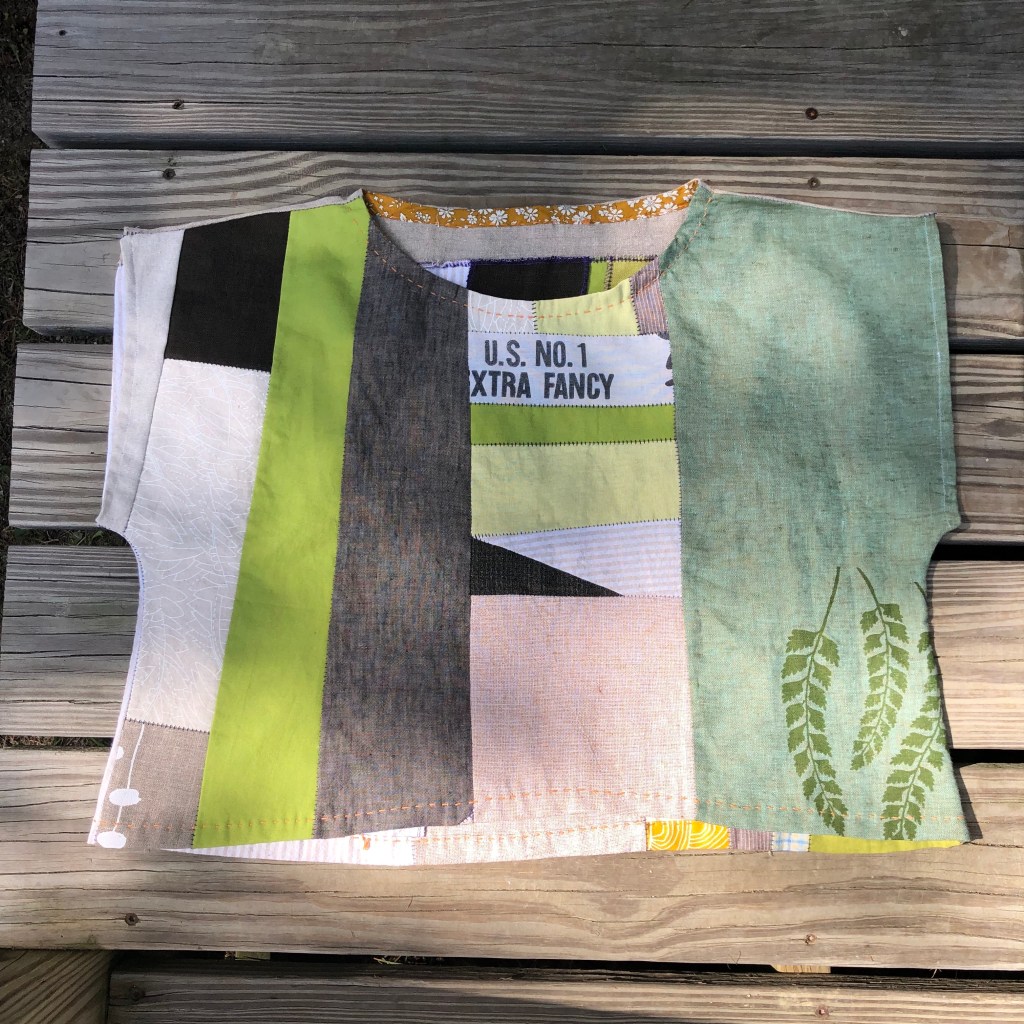
Sure, you can sew a garment with just one fabric. But have you ever dreamed of making your own unique PIECED textile garment? In this playful workshop, Cal and Katherine join forces to show you three different methods of making a patchwork boxy top/tunic: improvising yardage, engineering a pattern, and piecing onto a foundation. You’ll have time to experiment with the options before choosing your approach to making your own one-of-a-kind top! You can incorporate favorite leftovers from other projects, treasured small bits, upcycled clothes and thrifted gems as your source material. Transforming textile waste into fantastic clothing is not only really satisfying, it also keeps perfectly good material out of the landfills, and is friendly on the wallet to boot. Plus every garment will be a one-of-a-kind work of art!
This class is designed for folks who already have some basic sewing skills under their belt. You should be comfortable threading and troubleshooting your sewing machine without assistance.
Homework: Please arrive to class with 2 copies of your pattern already traced and cut out on paper. Note: Because we will be working with patchwork, you will need to trace out the full shape, not the halfway down the center.
Supplies:
- Sewing machine (a limited number of machines will be available to use)
- Approximately 2+ yards (total) of smaller pieces of woven fabrics, special remnants, old garments, etc to be combined into your project
- 2 yards muslin or inexpensive lightweight woven fabric (to be used as hidden foundation/lining)
- A few sheets of 18 x 24” or a 14+” roll of paper (tracing paper, newsprint or sketch pad are all great)
- All-purpose thread
- Bias tape, 1 yard of ½” single-fold, can be self-made or packaged
- Basic sewing kit: Pins + cushion, scissors, seam ripper, tape measure, marking tool (chalk, wax or pencil) and ruler
- Roll of painters tape, any color.
Pattern for simple top:
Boxy Tee/Drapy Tunic: drafted in a previous class with Cal, or from her online video class, or tutorial found on her website (NOTE: please just do the simple version without the seam and pocket): https://calpatch.com
Lou Box Top https://www.sewdiy.com/shop/lou-box-top-pdf-pattern
Fen Top https://fancytigercrafts.com/products/fen-pdf-pattern
All Well Box Top https://www.etsy.com/listing/713038843/all-well-box-top-sewing-pattern-hacking
Maya Top https://www.etsy.com/listing/206020747/pdf-maya-dress-and-top-sewing-pattern
Shirt No. 1 https://shop.100actsofsewing.com/products/100-acts-of-sewing-shirt-no-1-sewing-pattern
NOTE: These are loose-fitting tops, so you should be fine to choose the size called for your measurements. If you are concerned about a perfect fit, you may wish to machine-stitch a muslin/fit sample first to confirm size.
INTRO TO WHEEL SPINNING – Week 1 only
Casey Ryder | 9 hours
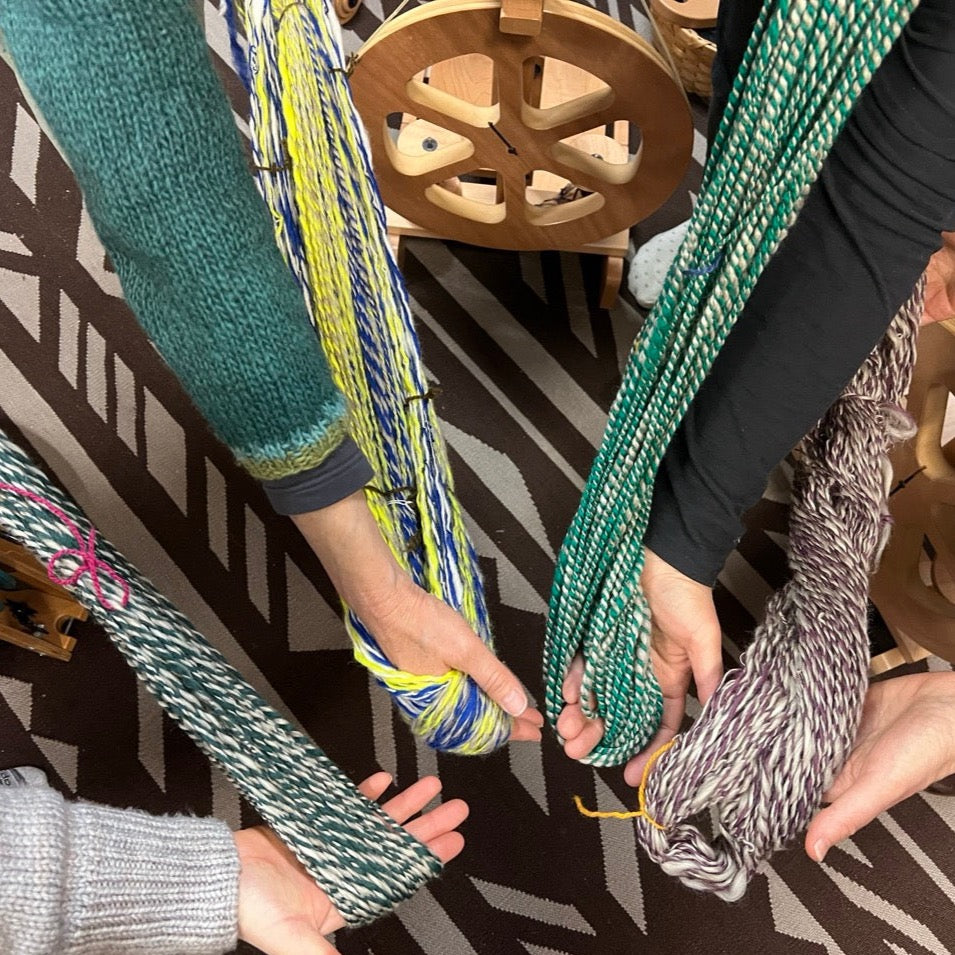
Want to take your yarn obsession to the next level? Learn the basics of wheel spinning: drafting, creating a singles, and making a 2-ply yarn. We will also talk about fiber prep and color blending while you practice hand-carding, drum carding, and using a blending board.
No experience is necessary, but you’ll need to be committed to spinning throughout the week in order to have two bobbins to ply together toward the end of the week. “How long?” is dependent upon how thick or thin you spin, but plan on an hour of practice each day after our first day together.
Materials Fee: $25 for 4 ounces of fiber
Wheel Rental Fee: $22 or you may bring your own wheel
If you’re bringing your own wheel, please be sure to have 3 bobbins and a lazy Kate
COLOR & WEAVING ON A RIGID HEDDLE LOOM – Week 2 only
Casey Ryder | 9 hours over 3 days
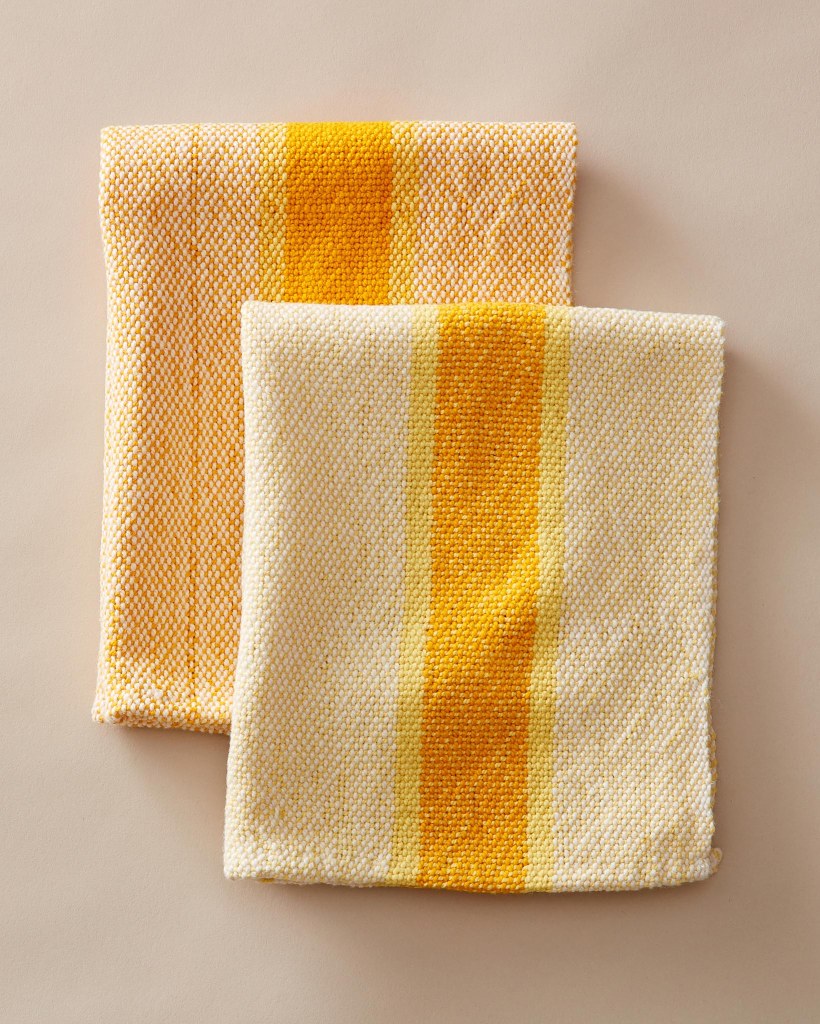
A rigid heddle loom is a portable loom that is quick to set up and allows you to weave yardage as opposed to being contained to the size of a frame like with tapestry weaving. If you’re curious about weaving, this is a great place to start! In this beginner class, you will learn how to warp and weave while exploring how color and pattern interact within plain weave.
We will be working with Gist Beam, a sport weight, cotton yarn that is beginner friendly and comes in a wide range of colors. You may also bring your own yarn if you prefer – at least two colors and 600 yards total of a sport weight cotton or plant fiber yarn.
No experience is necessary, but you’ll need to be committed to weaving throughout the week in order to finish. Please plan on 6-8 hours outside of class time to complete your weavings. You will have time to weave a table runner or two hand towels.
Materials fee: $68 for 3 cones or $45 for 2 cones of Beam in the colors of your choosing
Loom Rental Fee: $22 or you may bring your own loom with a 12 dent heddle
NEEDLE FELTED PAINTINGS
Casey Ryder | 3 hours
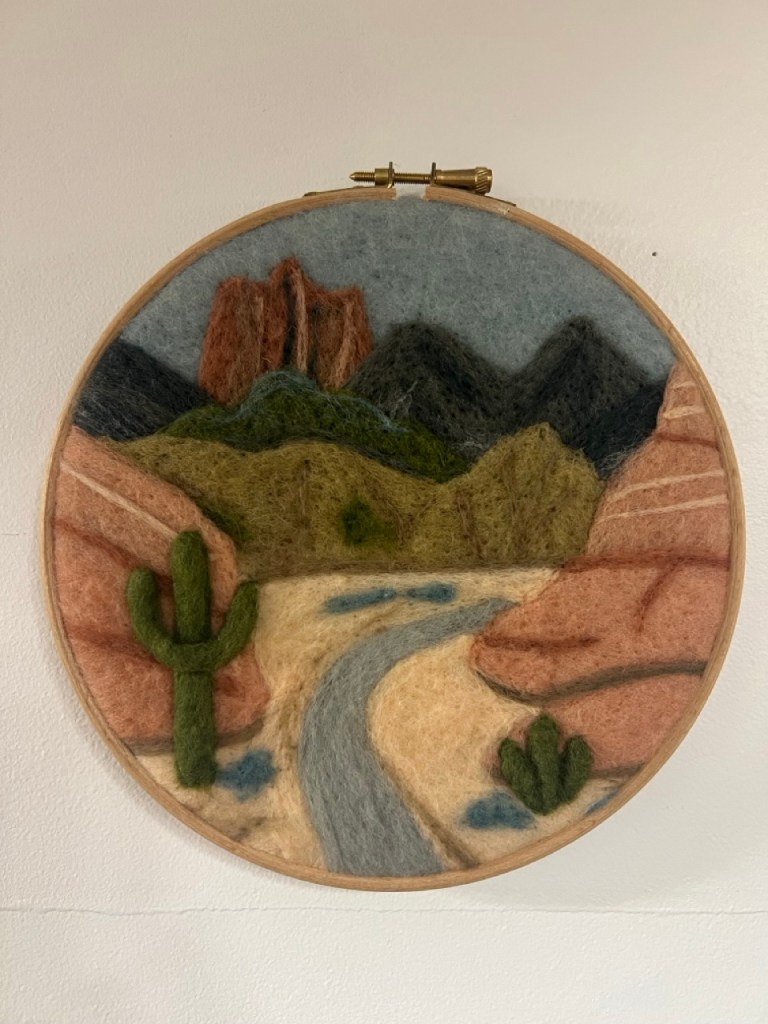
Needle felting is an easily accessible fiber craft. In this intro class, we will be working with kits from Felted Sky – think “paint by number,” but with wool fibers and a linen canvas. Each kit comes with a palette of wool roving, a linen fabric backing, felting needles, and a wooden embroidery hoop to display your finished artwork. You will learn the basic techniques of needle felting a landscape scene along with how to blend colors for more natural transitions. Casey will bring blending tools and multi-needle tools for you to try, too, which speeds up the process.
You will be able to pick out your kit design ahead of time. If you prefer to design your own scene, that can be arranged, too.
FELTED SOAPS
Casey Ryder | 2 hours
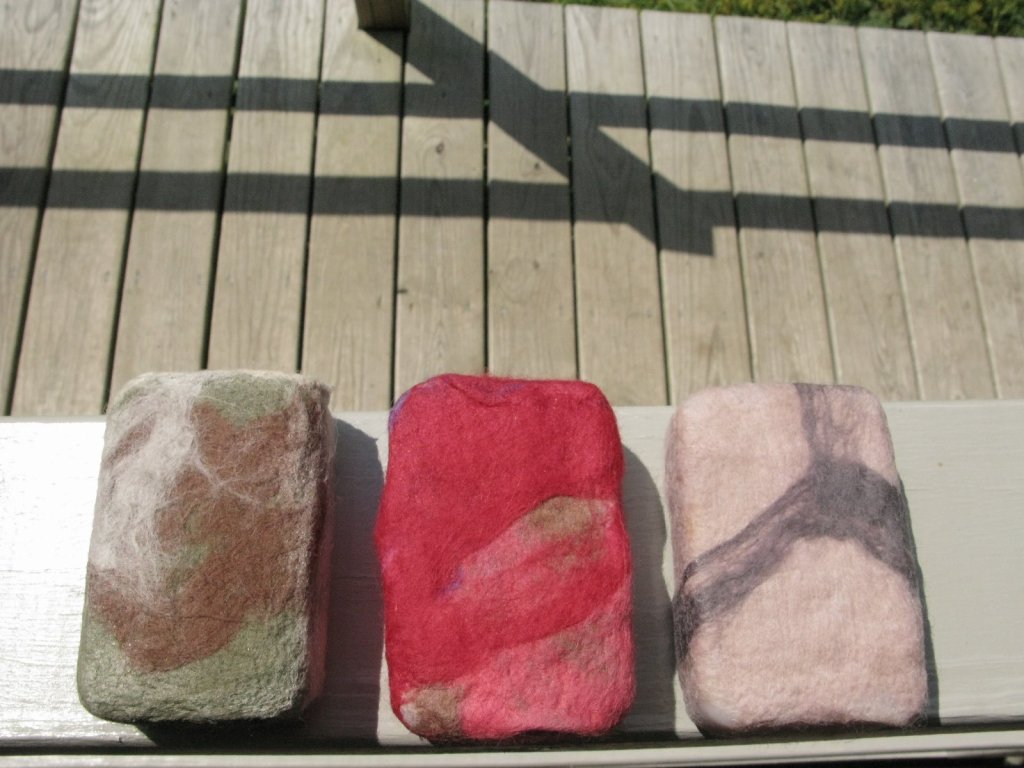
In this most basic wet-felting class, we’ll use Maine-made soap, wool roving, hot water, and a bit of friction to create wooly loofahs! Felted soaps are fun and easy and make great gifts or to treat yourself.
Expect to get sudsy and maybe a lil’ wet!
Materials Fee: $10
INTRODUCTION TO BASKETRY: Weaving with Natural Materials
Sarah Sockbeson | 8 hours
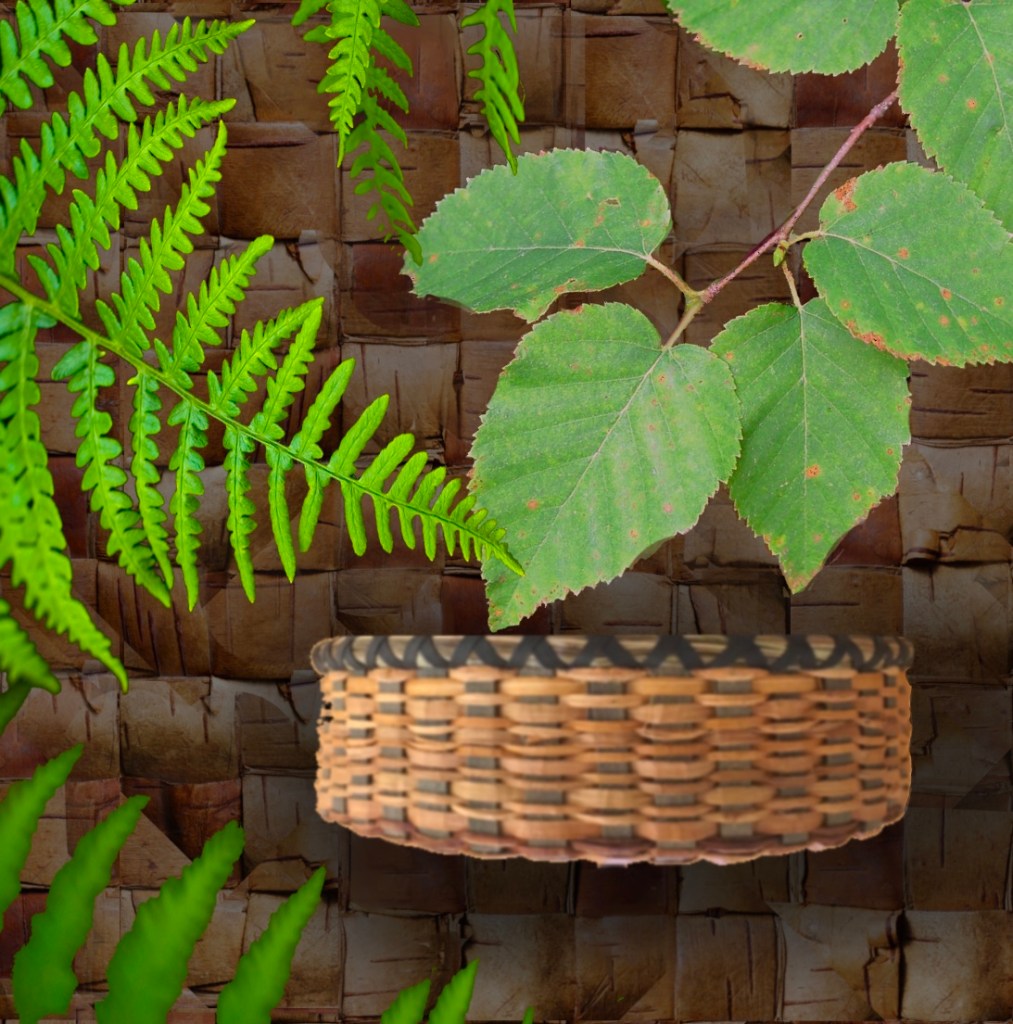
In this three-part introductory workshop, award winning Penobscot Ash and Sweetgrass Basketmaker Sarah Sockbeson will introduce you to the basics of basketry, opening the doorway to exploring this incredible fiber art form. You will learn several elemental basket weaving techniques using wild harvested fibers, and make a simple basket of your own design. We will begin with an introduction to weaving and a demonstration, and then take a walk together to identify and gather supplies around camp. We will identify and select plant or fiber materials and learn how to sustainably harvest on site. There are a number of densely populated seasonal plants around camp that are perfect for harvesting; from pine needles to birchbark, there are many possibilities to discover.
No previous weaving experience needed, but be prepared for light walking.
Tools for harvest will be provided for your use during class or bring your own pair of shears or plant trimmers.
WOVEN JEWELRY
Sarah Sockbeson | 3 hours
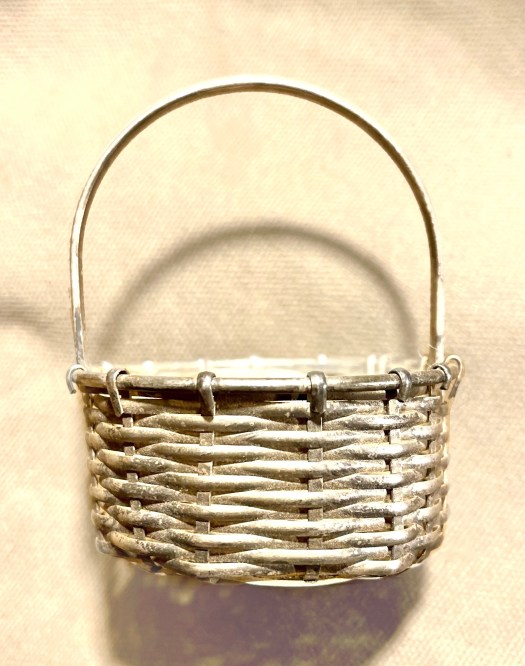
In this open studio style workshop, you’ll have the chance to design your own woven pendant or earrings, under the guidance of award winning basket maker, Sarah Sockbeson. Several techniques will be demonstrated, and then you’ll have time to explore and experiment on your own. There will be a treasure trove of materials to work with, including various types of wires and findings. You may choose to bring recycled jewelry findings from home to rework/ incorporate; maybe you have broken jewelry parts or a chain you’d like to make a pendant for? By the end of the workshop, you’ll have a one-of-a-kind wearable piece of art!
Materials fee:$10
WEARABLE PACK BASKET
Sarah Sockbeson | 8 hours
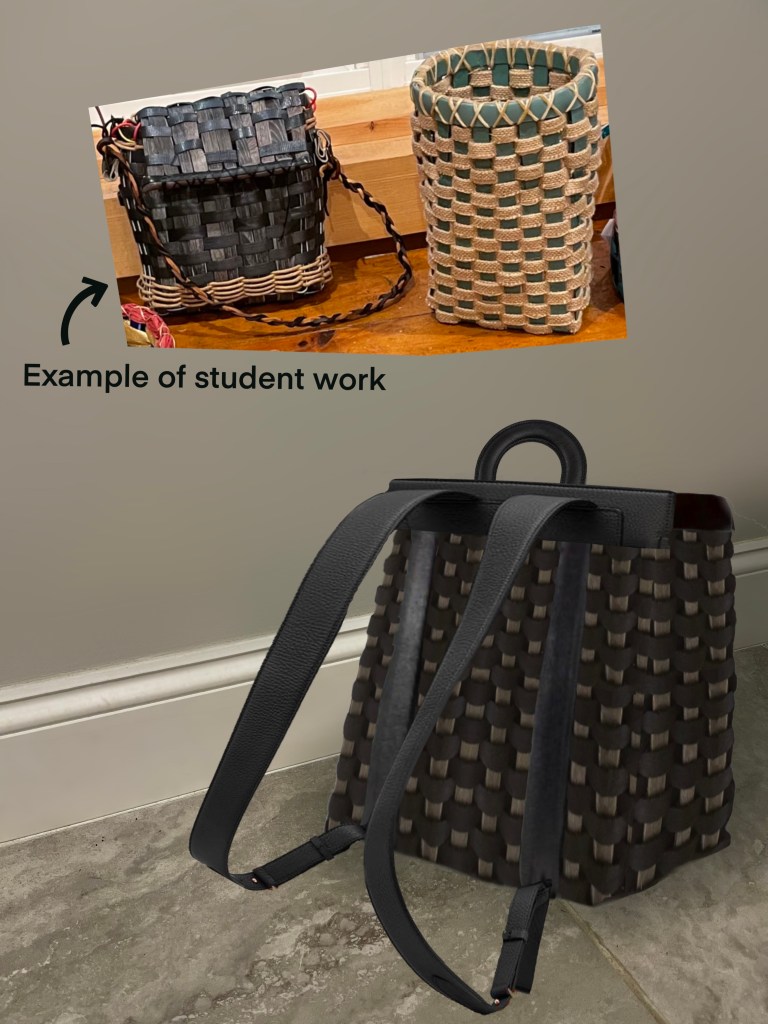
In this class, award winning Penobscot Ash and Sweetgrass Basketmaker Sarah Sockbeson will teach you how to make a small carryall pack basket OF YOUR OWN DESIGN, perfect for all your foraging adventures. Heavy duty pallet strapping will be supplied for the basic structural form, or you can choose from a vast selection of Sarah’s supplies, or bring any recycled or gathered materials from the suggested supplies list. After making the body of the basket, you’ll learn how to sew a fabric liner. Other finishing elements include straps, zippers, rivets and buttons, depending on your design. Some prior weaving experience will be helpful to get the most out of this class, though adventurous beginners up for a challenge are welcome. Note: each student will be designing and making their own pack basket, with Sarah’s guidance. Expect to spend 4-6 hours of weaving time outside of class if you want to finish your project.
Materials fee: $20, with optional add-ons: $5-10 depending on selection
NOTE FROM SARAH RE: SUPPLIES + MATERIALS:
I will bring a large assortment of materials, creating a communal pile for all of my classes. You are encouraged to bring your own materials as well, from the suggested list below, both for use in your own projects and to contribute to the communal pile.
Unless otherwise noted, fee is $20 to access communal pile.
The hope is to encourage the use of supplies that you are drawn to within the available options, to utilize and incorporate what you like/ what catches your eye, with the primary goal of allowing your imagination to lead your process, allowing the materials to guide you and opening the door through trial and error and experimentation. If one material doesn’t work, try another, or swap out one material for another depending on what works in your design and keep an open mind when developing your desired outcome.
If you choose to bring your own materials, I would strongly suggest everyone try to bring materials that don’t cost you anything, whether that be because you make/ produce the supplies personally, or because you gathered harvested it from nature/ processed or unprocessed as your contribution, or bring a form of supplies that you have no other use for/ have had on hand forever/ have never had the chance to utilize, or something that would be otherwise destined for the garbage or a recycling center (ideas listed below).
Note for anyone bringing freshly gathered/ natural materials:
Feel free to bring materials from any part of the country, just as long as it has been deemed “safe” to travel / treated in such a manner that it has no potential to contain any type of insect, disease or parasite. Invasive plants and insects are a known threat to native plant/ animals/ insect/human populations/ and our ecosystem as a whole, so please be mindful of proper harvesting practices, and avoid moving anything that could contain parasites or insects across state lines.
SUPPLIES (Suggested options):
This list is not meant to limit your imagination, but to provide possible suggestions of what may be a great contribution to our materials selection for any of my workshops
- wood veneer sheets or strips or edge banding wood, plastic, or other
- any type of yarn, cordage, rope
- wire, any type/ gauge, including recycled old wires, cords or cables, coated or not, wire coat hangers
- heavy weight paper, wallpaper, any type of thick paper, card stock, vinyl, watercolor paper, folders, document holders (plastic or paper)
- sticks, branches, willow, reed, bark, root, grass, flax, pine needles, yucca, palm fronds any other type of fibrous natural harvested material leaves or renewable plant materials, prepared or not (the more flexible the better)
- plastic or composite that can be cut into strips or used as a rigid base material
- shopping bags of any kind, paper, plastic,
- old fabric scraps, (longer strips or pieces that can be cut or braided)
- any type of basketry or caning supplies
- any type of fiber you can think of or enjoy working with
Have fun using your imagination and pondering over the possibilities…
Shuttle Tatting Basics
Bleu Vermeer | 3 Hours
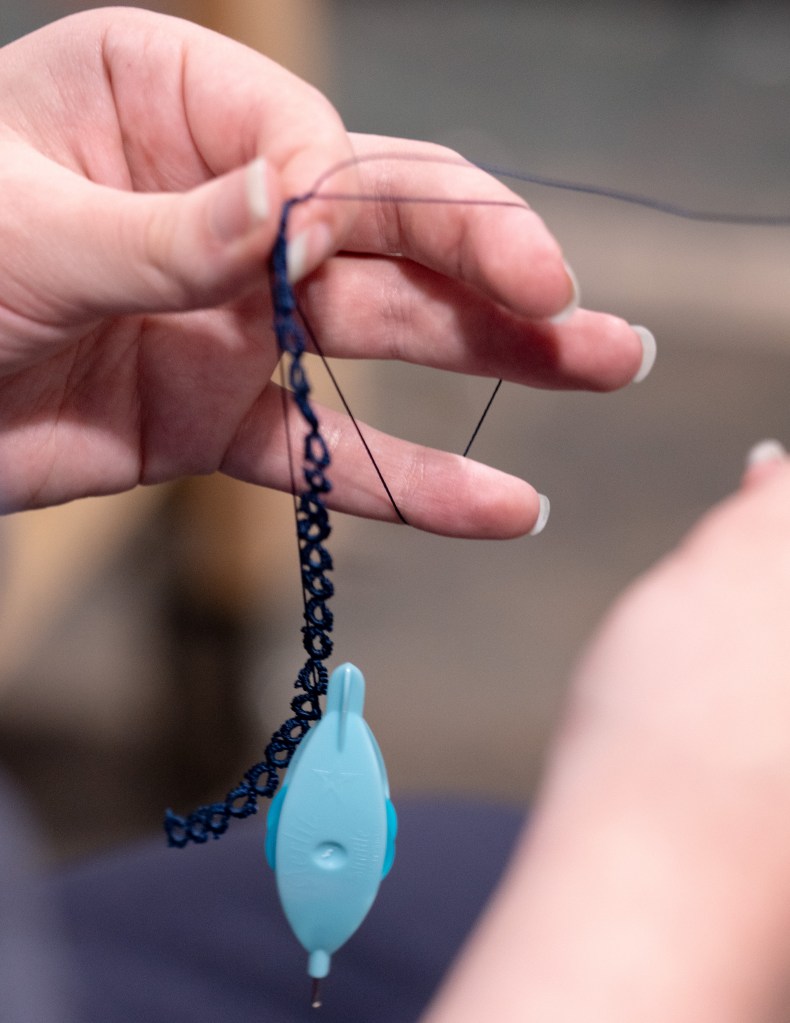
If you find joy in the slow, precise magic of fiber arts—or just like crafts that involve tiny tools and a touch of stubbornness—shuttle tatting might be your next favorite thing. In this beginner class, you’ll learn how to form the all-important double stitch, build rings and chains, and begin decoding the sometimes-baffling world of tatting patterns. It’s a skill that takes a little patience, but the payoff is a pocketful of delicate lace samples and the quiet thrill of making something delightfully intricate.
Materials Fee: $20
From Fluff to Form: 3D Needle Felting Basics
Bleu Vermeer | 3 Hours
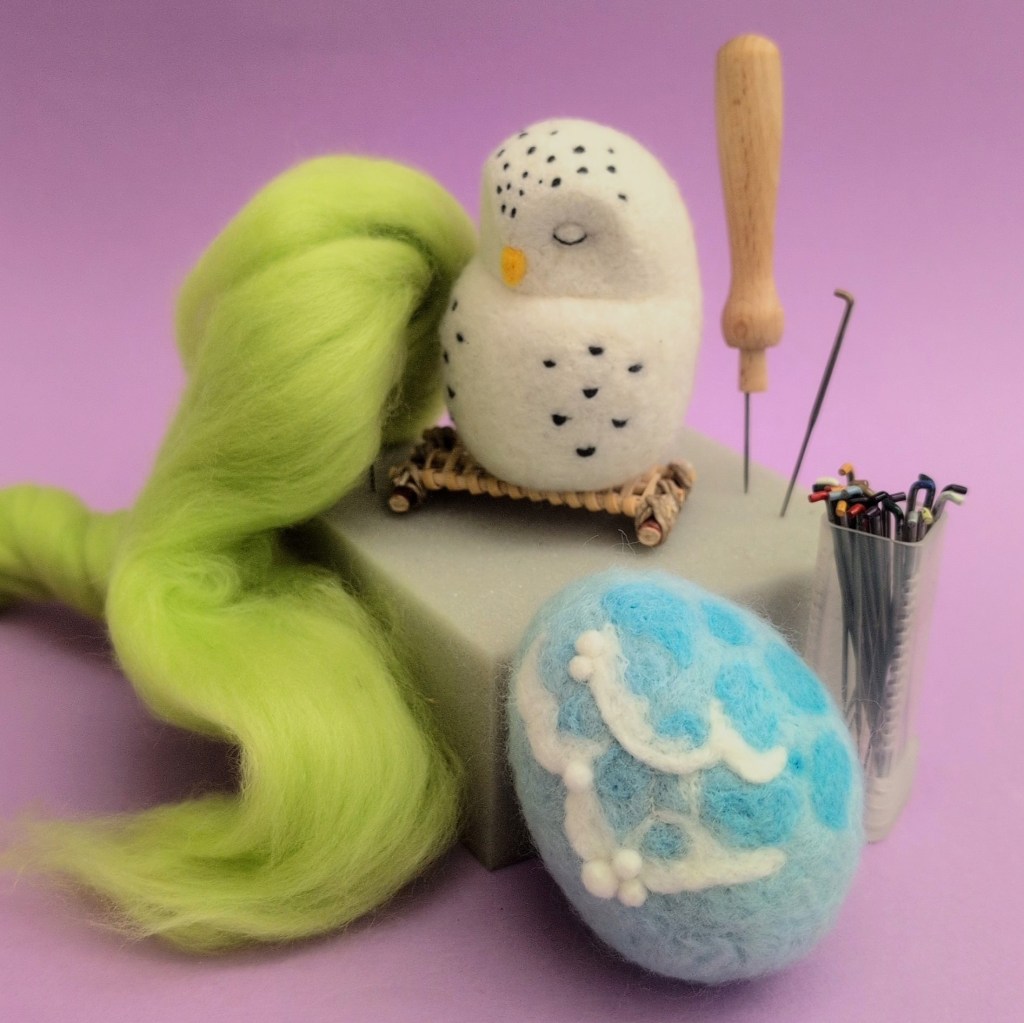
Needle felting opens up a world of soft sculpture—and this class will get you off to a confident start. In this skill-building class, you’ll learn how to create curves, corners, and points with control and intention. We’ll cover how to blend colors for natural shading, layer fiber for depth and detail, and securely attach separate pieces (like limbs or ears). Rather than focusing on a single finished object, students will leave with a series of sculpted samples that showcase their growing technique—great for reference and inspiration on future projects.
All materials and tools will be provided. Just bring your curiosity and a willingness to explore the possibilities of wool in three dimensions.
Materials Fee: $20
An Introduction to Knitting
Bleu Vermeer | 3 Hours
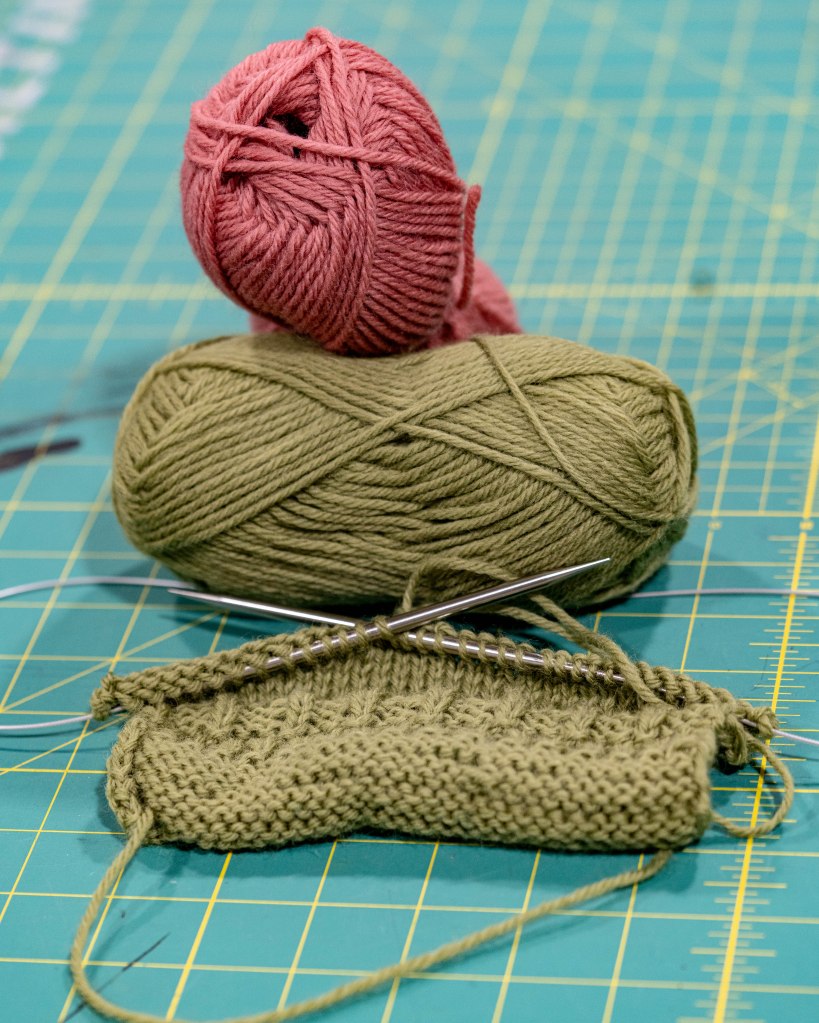
Have you always wanted to learn to knit but didn’t know where to begin? This relaxed, no-pressure class is the perfect place to start. In just three hours, we’ll demystify the basics and get yarn on your needles!
You’ll learn the long-tail cast on (my favorite for smooth and stretchy edges), the foundational knitting stitches that are the building blocks of just about every project, and how to bind off your work using Elizabeth Zimmermann’s sewn bind off—an elegant, stretchy finish that pairs beautifully with the long-tail cast on. As we go, you’ll create a simple stitch sampler—a swatch-sized record of your progress, showing off your growing skills and ready to serve as a handy reference for future projects.
This class is for absolute beginners and curious dabblers alike. If you’ve never touched knitting needles before, you’re in the right place!
 Medomak Fiberarts Retreat